

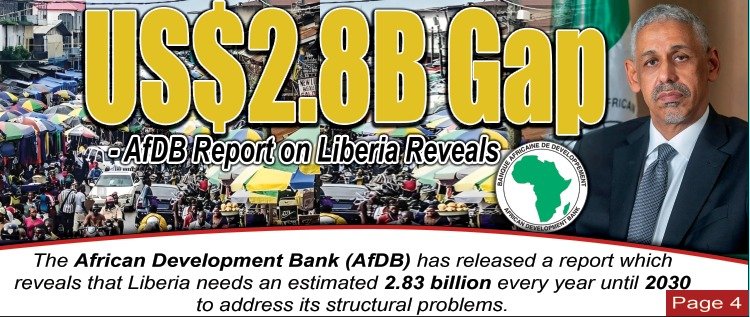
Liberia needs about US$2.83 billion in development financing every year through 2030 to address longstanding structural challenges and put the country on a stronger path to economic transformation, according to a new report by the African Development Bank (AfDB).
The report estimates Liberia’s annual financing gap at US$2.83 billion, or roughly 65.8 percent of the country’s 2024 Gross Domestic Product (GDP). The Bank says closing that gap is critical to sustaining economic growth, expanding infrastructure, creating jobs and reducing poverty.
While acknowledging recent progress, the AfDB said Liberia has made important strides in strengthening public financial management, expanding digital tax administration and improving transparency. Those reforms have boosted government efficiency and public confidence, but they have not been enough to meet the country’s growing development needs.
The report notes that Liberia continues to face limited fiscal space and remains heavily dependent on natural resource exports, foreign aid and remittances, making it difficult to finance major development projects from domestic resources alone.
To narrow the financing gap, the Bank recommends stronger domestic revenue collection, deeper financial markets, expanded public-private partnerships and greater investment from foreign investors, the Liberian diaspora and institutional investors.
According to the AfDB, mobilizing capital on a much larger scale will be essential if Liberia is to achieve faster, more inclusive and resilient economic growth.
The report also highlights encouraging signs in Liberia’s recent economic performance.
Real GDP growth increased from 4 percent in 2024 to 4.6 percent in 2025, driven mainly by mining, agriculture and stronger household spending, supported by remittances and public investment in infrastructure.
Inflation fell from 8.2 percent in 2024 to about 6 percent in 2025, reflecting tighter fiscal management and improved monetary policy. The report also points to a more stable exchange rate and modest growth in private sector lending as signs of improving macroeconomic conditions.
Liberia’s fiscal position strengthened during the period, with the budget deficit dropping from about 7 percent of GDP in 2023 to 1.8 percent in 2025, largely because of improved domestic revenue collection and tighter control of public spending.
The country’s external position also improved. The current account deficit narrowed to 14.4 percent of GDP, while foreign exchange reserves increased modestly, although they remain below recommended levels.
Looking ahead, the AfDB projects Liberia’s economy will expand by more than 5 percent in both 2026 and 2027, supported by continued growth in the mining and agriculture sectors. Inflation is also expected to ease further.
However, the Bank warns that Liberia’s outlook remains vulnerable to swings in global commodity prices, uncertainty in the world economy, governance challenges and declining concessional financing.
The report concludes that although recent reforms have strngthened the economy, Liberia will need sustained investment and broader sources of financing to close its development gap and achieve long-term economic growth.
The African Development Bank (AfDB) has released a report which reveals that Liberia needs an estimated 2.83 billion every year until 2030 to address its structural problems.