
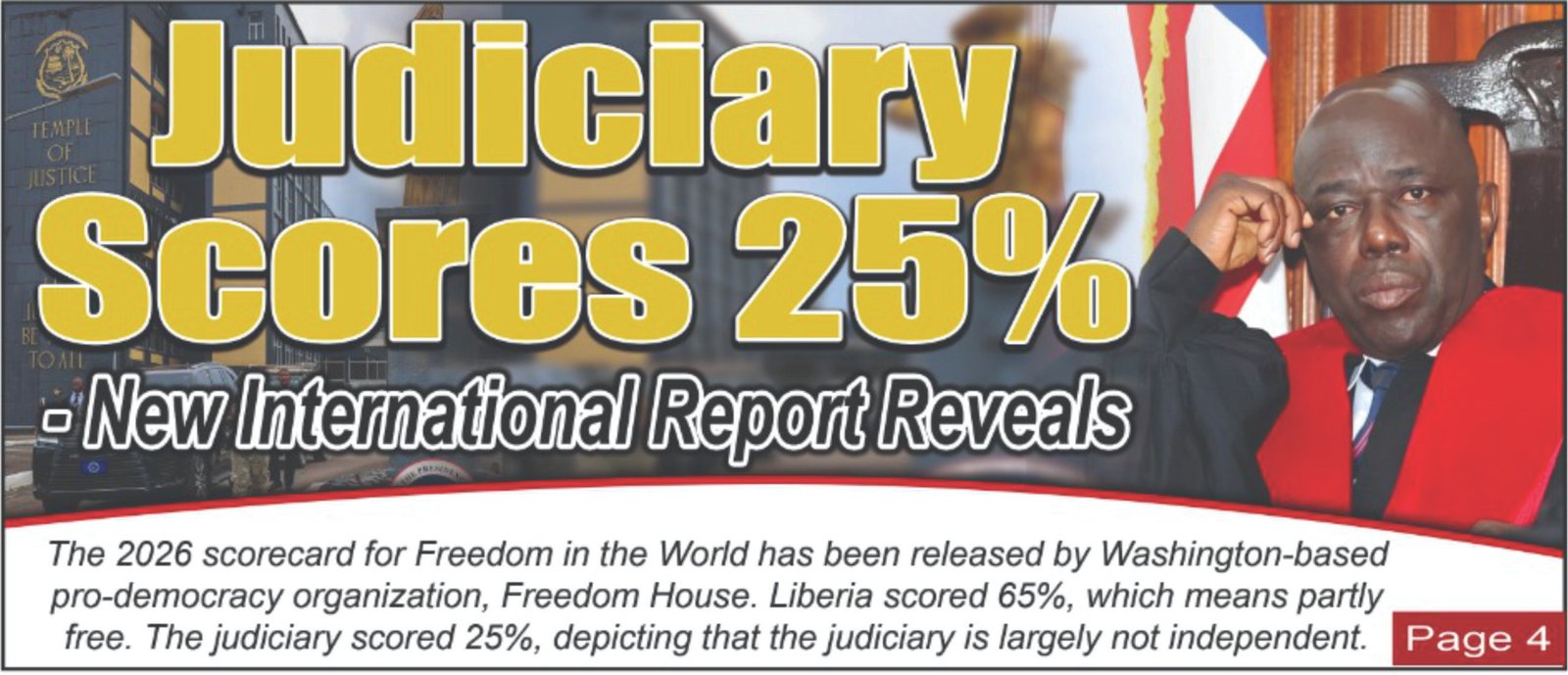
The 2026 scorecard for Freedom in the World has been released by Washington-based pro-democracy organization, Freedom House. Liberia scored 65%, which means partly free. The judiciary scored 25%, depicting that the judiciary is largely not independent.
The report classified Liberia as “partly free,” with an overall score of 65 percent, but highlights serious weaknesses in the rule of law, especially within the court system.
Under the rule of law category, judicial independence is rated at 25 percent (1 out of 4), while due process in civil and criminal matters also stands at 25 percent (1 out of 4). Protection from unlawful use of force is assessed at 50 percent (2 out of 4), and equal treatment under the law is also placed at 50 percent.
The report specifically notes: “Is there an independent judiciary?” scoring Liberia 1 out of 4, reflecting concerns about limited court independence and external influence on judicial processes.
On due process, the report again records 25 percent, pointing to continued concerns over fairness and consistency in the handling of civil and criminal cases.
Outside the judiciary, the report shows mixed results across other areas of governance and rights. Freedom of movement is rated at 75 percent (3 out of 4), while property rights and the ability to run private businesses without interference stand at 50 percent. Personal social freedoms, including family and marriage rights, are also rated at 50 percent, with economic opportunity and protection from exploitation similarly placed at 50 percent. In the political rights category, Liberia performs more strongly. Both presidential and legislative elections are rated at 100 percent (4 out of 4), reflecting generally free and fair electoral processes. Electoral laws and implementation are slightly lower at 75 percent (3 out of 4).
Political participation and competition also remain relatively strong, with most indicators ranging between 75 and 100 percent, including opposition activity and participation across different segments of society.
However, governance indicators continue to show challenges. Safeguards against corruption are rated at 50 percent (2 out of 4), while transparency in government operations also stands at 50 percent.
The report noted that recent anti-corruption actions, including the suspension of more than 450 officials for failing to declare assets to the Liberia Anti-Corruption Commission, contributed to an improved corruption score.
Civil liberties show a mixed picture. Freedom of expression and media independence is rated at 50 percent, while religious freedom and academic freedom are both rated at 75 percent. The ability to express political views without fear is also placed at 75 percent.
Associational rights are also varied. Freedom of assembly and NGO activity are rated at 75 percent, while trade union rights stand at 50 percent. The report concludes that while Liberia continues to hold credible elections and maintain relatively open political space, weaknesses in judicial independence, due process, and governance transparency remain major concerns for the country’s democratic development.