
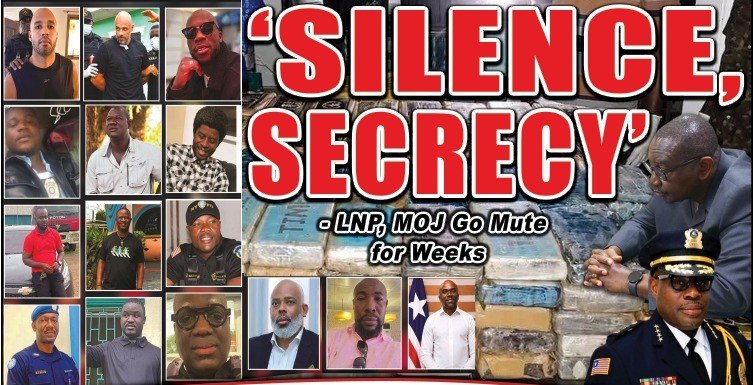
Amid two separate investigations into US$317 million and US$19 million drug busts, the Liberia National Police (LNP) and the Ministry of Justice (MOJ) have remained silent for more than three weeks, providing no updates on the investigations despite growing public distrust, suspicion, and calls for accountability and transparency.
The silence has raised questions about what has happened to the investigations and whether the public will be told how the cases are progressing.
The issue has also triggered a public exchange between Liberia’s Inspector General of Police, Col. Gregory O. W. Coleman, and Gbarpolu County Senator Amara Konneh over allegations surrounding the handling of the country’s major cocaine investigations.
In a social media post, Coleman warned public officials against making serious allegations without evidence.
“There is a fundamental difference between raising questions and claiming that state institutions are protecting a drug cartel,” Coleman wrote. “The first is legitimate oversight. The second is an allegation of serious criminal wrongdoing that must be supported by evidence.”
The IGP said such claims carry greater weight when they come from a sitting senator.
“When such a claim comes from a sitting senator, it carries greater weight and creates a corresponding responsibility,” he said. “If he possesses credible information, he should place it before the appropriate authorities so that it can be tested, investigated, and, where justified, prosecuted.”
Coleman also cautioned public officials about making statements that could affect ongoing investigations.
“Duty requires officials to report wrongdoing,” he wrote. “Good judgment requires them to consider whether public disclosures could alert suspects, compromise witnesses, expose sources, or disrupt an active investigation.”
He added: “Integrity requires courage to produce facts, not merely suspicions. Fairness requires that no one, senior or junior, be condemned without evidence and due process.”
According to Coleman, criticism is acceptable when it is based on facts, but unsupported allegations can have serious consequences.
“Criticism does not weaken institutions when it is responsible and evidence based,” he said. “But serious accusations made without supporting facts can prejudice investigations, damage innocent people, and ultimately help the criminal networks we are all seeking to dismantle.”
Coleman then challenged anyone with evidence to bring it forward.
“If there is evidence, bring it forward. It will be investigated without fear, favor, rank, or political consideration,” he stated.
“Accountability begins with speaking out, but responsible leadership requires something more: putting the evidence on the record,” he added.
Konneh Hits Back
Senator Konneh rejected the IGP’s response, saying it failed to address the concerns he had raised about the cocaine investigation.
“I have read the Inspector General of the Liberia National Police’s response and another security chief’s comments, which attempt to deflect from the core issue I raised in ‘The Danger of Silence in the Cocaine Investigation,’ which I posted yesterday,” Konneh wrote.
He said the matter was not about politics but about national security.
“Let me be clear: this is not political gossip,” Konneh said. “It is about our republic’s survival in the face of two converging national security threats: the penetration of multi-million-dollar drug cartels deep into Liberia and the erosion of territorial integrity along our northern border.”
“Together, they endanger our youth, our sovereignty, and the state’s stability,” he added.
Konneh accused the security system of treating junior officers more harshly than senior officials when major drug cases emerge.
“Whenever major narcotics operations are uncovered in our country, a troubling and cowardly pattern emerges,” he wrote. “Junior officers, the foot soldiers, are swiftly punished, scapegoated, or thrown under the bus without due process, and our courts rule in the cartel’s favor.”
“No one is penalized by our system when we have one of the most stringent drug laws in West Africa. Zip! Nada!” he added.
He further alleged that senior officials who have been suspended or dismissed have not faced the same level of scrutiny.
“Meanwhile, suspended and dismissed senior leaders remain comfortably at home, shielded from scrutiny by their bosses in air-conditioned offices, and allowed to maintain a facade of business as usual,” Konneh stated.
“Not a single one of them has faced a judge. This imbalance undermines public confidence and raises legitimate questions about institutional integrity,” he added.
Konneh said an independent investigation is needed because security agencies should not be left to investigate allegations involving their own leadership.
“No security institution can credibly investigate allegations involving its own leadership or inner circle,” he wrote. “Such cases require independent, transparent oversight. This is not optional.”
He then raised several allegations involving security personnel.
“A senior officer admitted to receiving money from individuals linked to the cartel to ‘provide comfort’ after an arrest, which the IG has admitted,” Konneh alleged.
“Another officer, the Officer in Charge at the Drug Enforcement Agency, is alleged to have received a vehicle from cartel actors,” he added.
Konneh also alleged that the Chief of Highway Patrol used a police vehicle to escort drugs.
“The Chief of Highway Patrol used a police vehicle to escort the drugs; according to public sources, he had instructions from above in the chain of command,” he wrote.
He said the allegations were not created by politicians.
“These claims did not originate from politicians,” Konneh stated. “They came from within the security services and the investigation the IG oversees, and were leaked to media outlets and a Liberian activist living in exile, leading to arrests and administrative action.”
The senator also questioned reports that individuals linked to the alleged cartel may have supplied Starlink equipment to the police.
“Additionally, there is a serious allegation that the cartel might have supplied Starlink equipment to the national police,” Konneh wrote.
“So far, the Police IG or the Liberia National Police has not denied this claim with any documentary proof showing how the equipment was obtained,” he added.
Konneh said the lack of an explanation could further damage public confidence.
“In a time when public trust is fragile, silence on such issues does not reassure the nation,” he stated.
He called on the police leadership to respond directly to the allegations.
“The responsibility for disproving these allegations with facts and accountability lies directly with you at the top, not with me, doing my constitutional oversight job by advocating for an independent investigation,” Konneh wrote.
“Accountability begins at the top,” he added.
The senator warned that continued silence could create the impression that senior officials are protecting people connected to the alleged drug network.
“If individuals within a command structure are implicated in bribery, improper inducements, or cartel-related interactions, continued silence risks being interpreted as institutional protection,” Konneh said.
“Liberia cannot afford even the perception that a cartel has penetrated the state,” he added.
Konneh also called on Coleman to step aside while the allegations are investigated.
“You cannot hide behind technicalities or point fingers at lawmakers performing their constitutional oversight duties,” he wrote.
“Step up, address the specific corruption allegations within your immediate ranks, and allow an independent and transparent investigation to proceed without interference,” he added.
“Remaining at the helm while an active and high-profile narcotics probe implicates close associates taints the entire integrity of the Liberia National Police,” Konneh stated. “The honorable course of action is to step aside, Mr. IG.”
Defending his role as a senator, Konneh said his responsibility is to raise concerns and demand answers, not conduct criminal investigations.
“My role as a senator is not to conduct criminal investigations,” he wrote. “It is to raise concerns when the public interest is threatened and to demand accountability from those entrusted with national security.”
“I will continue to do so,” he added. “Constitutional oversight cannot be reframed as obstruction, and public scrutiny cannot be dismissed as prejudice to an investigation.”
Konneh also acknowledged his political differences with the Boakai administration.
“I did not vote for President Boakai and labor to help bring this government to power only to watch our state institutions, especially our security institutions, drift toward compromise by criminal networks,” he wrote.
“Silence is not an option for me, and no amount of deflection will weaken the demand for real accountability,” he added.
Senate Committee Awaits Briefing
Konneh said the Senate Committee on Defense, Security and Intelligence, of which he is a member, has not received a formal briefing from the police or members of the task force since their appearance before the Senate Plenary on July 1.
“Neither the IG nor any members of the task force have formally briefed the Senate Committee on Defense, Security, and Intelligence, of which I am a member, since their appearance before the Senate Plenary on Wednesday, July 1, 2026,” he said.
“Our requests have been brushed aside,” Konneh added.
He described the fight against drug trafficking as a responsibility shared by the country’s leaders.
“We, the leaders of our country whom our people have entrusted to protect them and our country from threats of any kind, have a rendezvous with destiny,” he wrote.
“Everybody wins when our country is free of drugs,” he added.
IG Requests Evidence
In another social media post, Konneh confirmed that Coleman had formally asked him to provide evidence backing his public statements about the cocaine investigation.
“I can confirm that I received a letter from the IG of LNP requesting evidence of my public statements about the cocaine case,” Konneh wrote.
“The Senate Committee on Security has reviewed it & I’ve asked my lawyers to acknowledge receipts to the IG,” he added.
The exchange comes as the public continues to wait for a detailed account from the LNP and the Ministry of Justice on the progress of the two major drug investigations.
With allegations involving security personnel now part of the public debate, pressure is growing on the authorities to explain what has been established, who has been investigated and what action, if any, has been taken.
For many Liberians, the issue is no longer only about the drugs seized. It is also about whether the institutions responsible for fighting drug trafficking can be trusted to investigate themselves openly and fairly.