


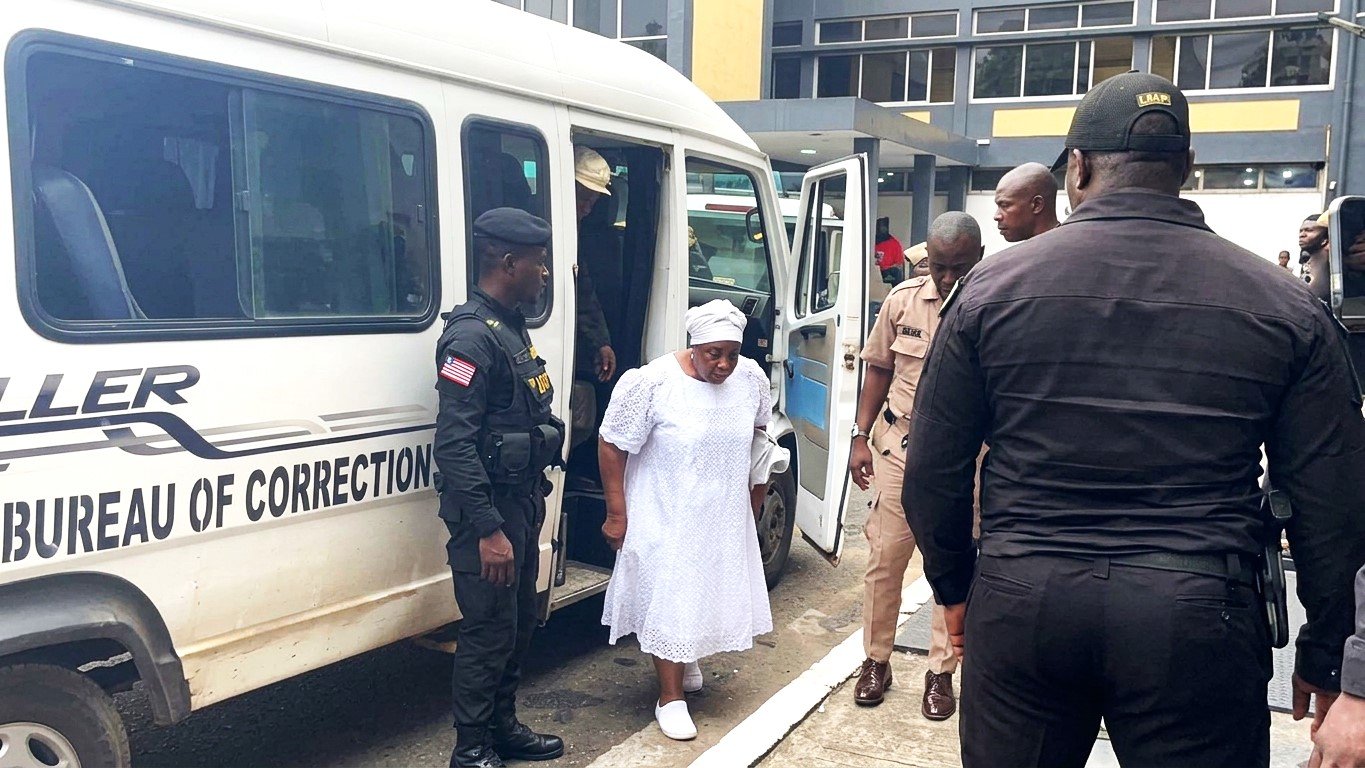
The preliminary hearing involving former Vice President Jewel Howard-Taylor is continuing at the Monrovia City Court after the defense’s request for the prosecution to turn over its evidence was denied.
Defense lawyers asked the court to order prosecutors to provide the evidence they are relying on to prosecute Taylor, arguing that the materials are necessary for the defense to prepare its case.
The prosecution opposed the request, arguing that the Monrovia City Court does not have jurisdiction to determine whether Taylor is guilty or innocent.
Prosecutors maintained that the court is only conducting a preliminary examination to determine whether the State has presented enough evidence to establish probable cause and send the case to the Circuit Court.
The court subsequently denied the defense motion.
The ruling came as the prosecution began presenting its evidence, calling Raphael Wilson, Commissioner of the Crime Services Division of the Liberia National Police, as its first witness.
Wilson is expected to testify about the police investigation and evidence gathered in connection with the case.
What the law says
Liberia’s Criminal Procedure Law makes clear that a preliminary examination is different from a trial.
Under Section 12.2, a defendant is entitled to a preliminary examination only when the defendant requests one. The law states:
“A preliminary examination shall be given a defendant after his first appearance before the magistrate or justice of the peace only if he requests it.”
Section 12.3 then requires the magistrate to hear the evidence. It provides:
“If the defendant requests a preliminary examination, the magistrate or justice of the peace shall hear the evidence within a reasonable time.”
The accused also has the right to confront the State’s witnesses. The same section states:
“All witnesses shall be examined in the presence of the defendant and may be cross-examined.”
At the end of the hearing, the magistrate does not decide guilt or innocence. The question is whether the evidence establishes probable cause.
Section 12.3 provides that where probable cause is established, the court “shall forthwith hold him to answer in the Circuit Court”; otherwise, the defendant must be discharged.
That is the basis of the prosecution’s argument that the City Court is not conducting a trial. Its immediate task is to determine whether the case should proceed to the Circuit Court.
The defense’s discovery request, however, also brings Section 17.2 of the Criminal Procedure Law into focus.
That section allows a court, on motion, to order the production of specified “books, papers, documents, or other things” before trial or before they are introduced into evidence. It also permits the parties and their lawyers to examine and make copies of those materials.
Section 17.2 therefore provides a mechanism for obtaining and examining specified evidence before trial. But the provision does not expressly give the defense an unrestricted right to every item of evidence in the prosecution’s possession during a preliminary examination.
The issue before the City Court, therefore, is not whether the defense can challenge the State’s evidence. The law expressly allows the defense to be present and cross-examine prosecution witnesses during the preliminary examination.
The dispute is whether the court should also compel the prosecution, at this stage, to provide the broader discovery requested by the defense.
With the discovery motion denied, the prosecution has proceeded with its evidence.
Commissioner Wilson is currently the State’s first witness, as the preliminary hearing continues before the Monrovia City Court.