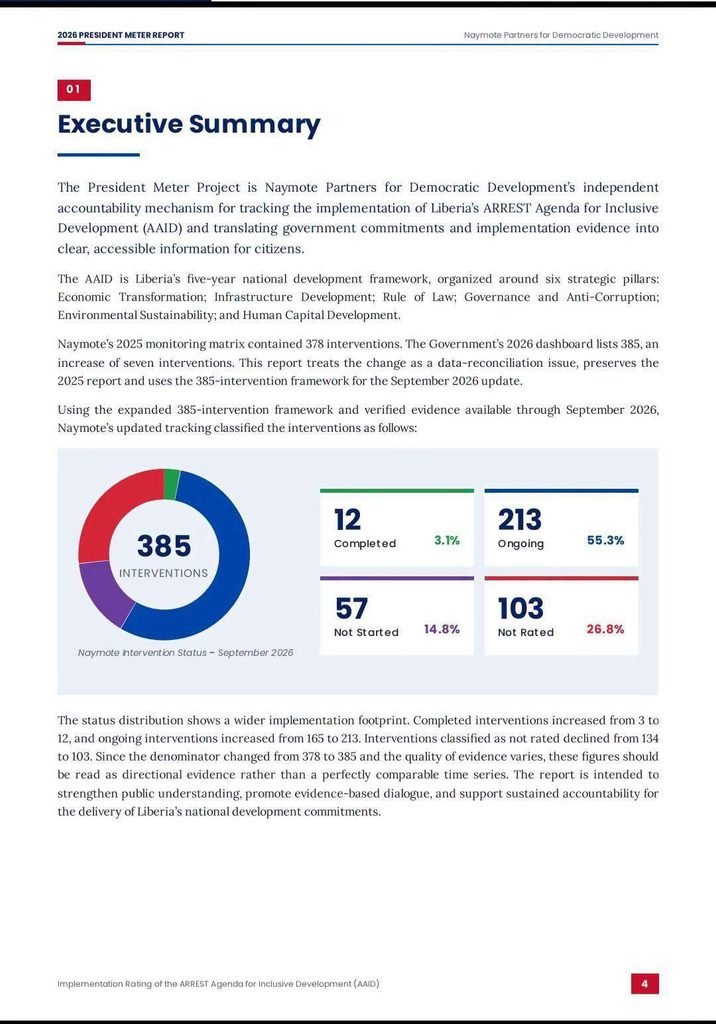



Naymote Partners for Democratic Development says only 12 of 385 government interventions under President Joseph Nyuma Boakai’s ARREST Agenda for Inclusive Development (AAID) have been completed, representing just 3.1 percent of the national development agenda monitored through September 2026.
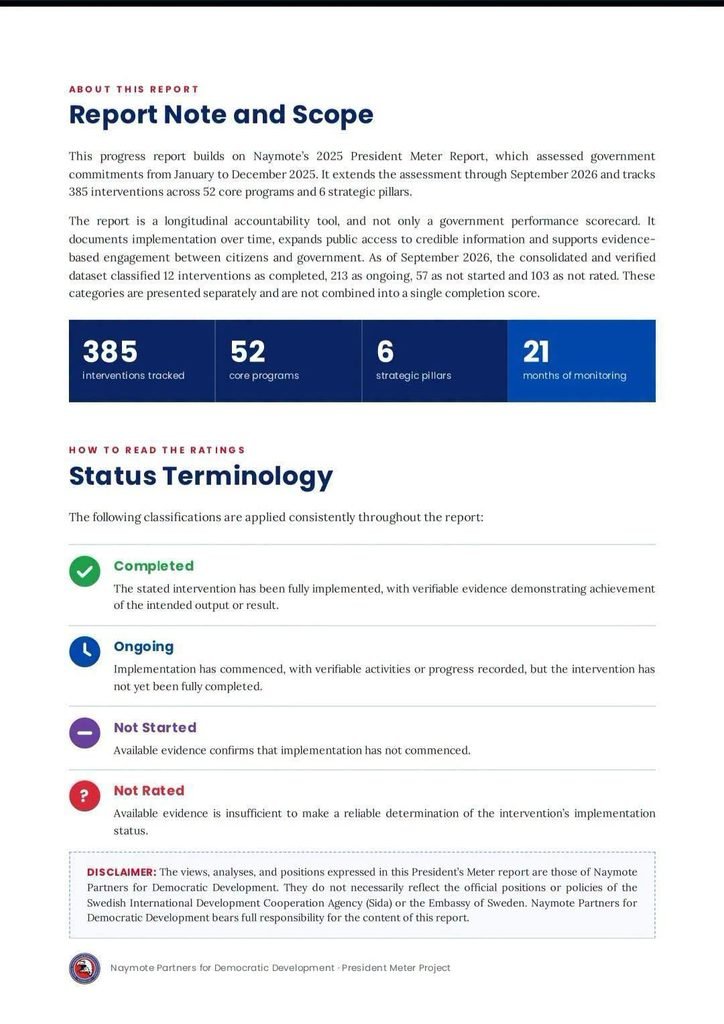
According to Naymote’s latest President Meter Report, released after 21 months of monitoring, 213 interventions, or 55.3 percent, remain ongoing, while 57 interventions (14.8 percent) have not started and 103 interventions (26.8 percent) could not be rated due to insufficient evidence.
The report puts the overall implementation activity at 58.4 percent, but warns that the figure should not be interpreted as a completion or impact score.
Naymote says the key accountability challenge now is moving the large portfolio of ongoing projects from implementation to completed outputs and measurable improvements in citizens’ lives.
The report identifies Infrastructure Development as the highest-performing pillar by activation rate at 67.3 percent, followed by Governance and Anti-Corruption at 63.7 percent, Environmental Sustainability at 63.3 percent, Rule of Law at 60 percent, Economic Transformation at 55.4 percent, and Human Capital Development at 53.1 percent.
However, Naymote raises concern over the 103 interventions classified as “Not Rated,” saying the figure reflects a significant information and accountability gap.
The organization cites inconsistent information-sharing by government institutions, limited publication of progress reports, and inadequate access to supporting implementation records.
The report also notes that the number of ongoing interventions increased from 165 in the 2025 assessment to 213 in 2026, while completed interventions rose from 3 to 12.
Naymote says the emerging picture is “not one of inactivity” but rather a national development agenda with a substantial portfolio of work in progress.
The accountability question, it says, is now whether these interventions will be completed on time, within budget, at acceptable quality, equitably across counties, and with measurable benefits for citizens.
The monitoring covers the period January 2025 to September 2026 and assesses 385 interventions across six strategic pillars and 52 core programs.