
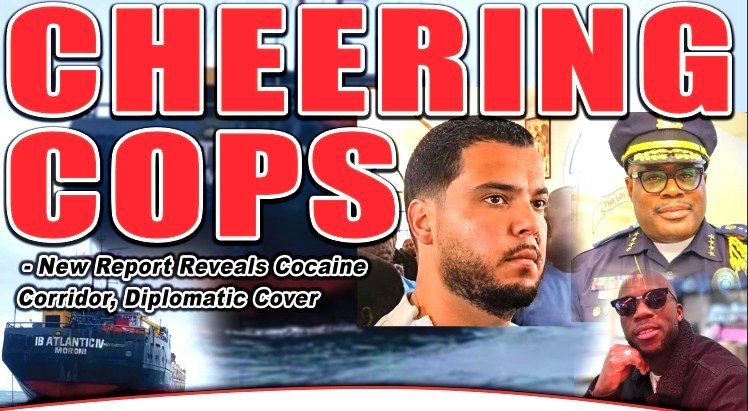
MONROVIA — A major investigation by the British investigative newspaper, The Guardian, has raised fresh concerns about Liberia’s potential role in a widening West African cocaine trafficking network, reporting that Liberian police officers applauded a convoy carrying Jos Leijdekkers, a Dutch fugitive described as one of Europe’s most wanted cocaine traffickers, as it crossed into Sierra Leone on July 20, 2026.
The October 14 investigation, which drew on interviews with intelligence and police sources across two continents, alleges that Leijdekkers’ network established operational bases in Liberia, Guinea-Bissau, and Ghana, raising questions about the ability of regional security institutions to detect and disrupt transnational organized crime.
The report places Liberia under renewed scrutiny following the seizure of nearly four tonnes of cocaine near Monrovia in July, a separate major cocaine interception at Roberts International Airport, and continuing questions surrounding the IB Atlantic IV, a foreign-flagged vessel that entered Liberian waters under circumstances the government promised to investigate.
POLICE CONDUCT UNDER SCRUTINY
The most troubling allegation in The Guardian investigation concerns the reported conduct of Liberian police officers during Leijdekkers’ cross-border movement.
According to the publication, witnesses described officers applauding the convoy as it crossed from Liberia into Sierra Leone. The report also stated that sources placed Leijdekkers in Liberia shortly before the announcement of a record cocaine seizure near Monrovia.
If independently substantiated, the reported conduct could raise serious questions about whether law enforcement personnel knew the identity of the convoy’s occupants, why officers were present, and whether any official security arrangements facilitated the movement.
Verity News could not independently establish the identities of the officers allegedly involved, the circumstances surrounding the convoy, or whether a separate Liberian investigation has examined the specific allegation.
The Liberia National Police and relevant government authorities should clarify whether the reported incident has been investigated, whether officers have been identified, and whether any disciplinary or criminal proceedings have followed.
RECORD COCAINE SEIZURE DEEPENS QUESTIONS
On July 21, 2026, Liberian authorities announced the seizure of nearly four tonnes of cocaine near Monrovia, a case that The Guardian linked to Leijdekkers’ alleged network. The British publication valued the shipment at approximately £235 million.
The scale of the seizure raises questions beyond the quantity of drugs recovered: investigators must establish how the shipment entered Liberia, who financed and transported it, who controlled the storage location, and whether any individuals within public institutions facilitated the operation.
The Guardian reported that sources identified a man arrested in connection with the Monrovia cocaine seizure as someone previously seen with Leijdekkers in Freetown, Sierra Leone. The newspaper also reported that Leijdekkers returned to Freetown from Liberia on July 20, the day before the seizure was announced.
These accounts strengthen the case for cross-border cooperation among Liberian, Sierra Leonean, Dutch, and other relevant law enforcement agencies. However, the precise nature of the alleged relationship between Leijdekkers and the seized shipment remains a matter for investigators and the courts to establish.
The case also follows an earlier major cocaine interception at Roberts International Airport on June 7, when authorities discovered approximately 237.6 kilograms of cocaine concealed in cargo declared as seasoning cubes. The shipment was valued at more than US$19 million, and five suspects were subsequently charged, according to The Guardian.
Taken together, the cases have intensified demands for a transparent account of how large consignments of cocaine can enter or move through Liberia and whether existing security and border-control systems are sufficient to detect them.
QUESTIONS SURROUND INSPECTOR GENERAL COLEMAN
The controversy has also intensified public scrutiny of Police Inspector General Col. Gregory O. W. Coleman, with political figures and civil society actors raising concerns about the leadership and credibility of the country’s security institutions during the ongoing narcotics investigations. Col. Coleman has been widely accused of ordering police escorts for alleged drug traffickers and money launderers, including Stephane Audrey Kpoto, who was seen multiple times with police escorts.
Among those demanding accountability over the wider cocaine cases are Alexander B. Cummings of the Alternative National Congress (ANC) and Cllr. Tiawan Saye Gongloe of the Liberian People’s Party (LPP).
Cummings has called for an independent international investigation into the government’s handling of the cocaine cases, while Gongloe has urged President Joseph Nyuma Boakai to establish an independent commission of inquiry to investigate the seizures, trace the money behind the alleged trafficking network, and determine whether individuals within the security or political establishment helped facilitate the operations.
Clarence Moniba of the Liberian National Union (LNU) has also been identified in the concerns supplied to Verity News as among the former 2023 presidential candidates calling for action concerning the Police IG.
The calls reflect broader concerns about public confidence, institutional accountability, and the need to ensure that investigators can pursue evidence without interference.
Concerns about the integrity of the investigations have also been heightened by the dismissal of Johnny Bolar Dean, the former Chief of Intelligence of Unit 106 of the Liberia National Police.
On July 23, 2026, it was reported that Coleman dismissed Dean following allegations that he had accepted a US$10,000 bribe to provide favourable treatment to two suspected drug traffickers held at Police Headquarters in Monrovia.
The report said Dean was referred to the Police Professional Standards Division for investigation.
The allegation is significant because it concerns the potential compromise of police handling of suspects in a major narcotics case. However, an allegation of bribery is not equivalent to a conviction, and the outcome of any subsequent investigation must be established through official records.
The episode raises questions about internal controls within the police, the safeguards governing access to suspects, and the mechanisms used to prevent interference with evidence and investigations.
It also underscores why a credible inquiry into allegations of institutional compromise must be capable of examining conduct at every level rather than focusing exclusively on junior personnel.
THE MYSTERY OF THE IB ATLANTIC IV
A separate maritime episode has added another dimension to the growing questions about Liberia’s ability to monitor suspected trafficking activity in its territorial waters.
The IB Atlantic IV, a vessel flying the flag of Comoros, attracted attention after being spotted off York Island in Tewor District, Grand Cape Mount County. Its presence prompted concern among local residents and fishermen, while the Liberia National Coast Guard subsequently pursued the vessel after it departed Liberian waters.
According to the Liberia News Agency, Information Minister Jerolinmek M. Piah disclosed in August that Ivorian authorities had arrested the vessel after it left Liberia. The government said it was communicating with Côte d’Ivoire to facilitate the ship’s return for further investigation.
The minister also disclosed that a Liberian fishing vessel had gone out to meet the IB Atlantic IV, prompting the National Fisheries and Aquaculture Authority to investigate the encounter.
Subsequent reporting by Verity News on August 27 indicated that the vessel had returned to Liberia and was in the custody of the Liberian Coast Guard. The newspaper quoted port sources who said they did not know the vessel’s contents or the identities of its crew because a full examination had not yet been conducted.
The government should clarify whether the vessel has been fully searched, whether its cargo and crew have been documented, whether investigators established its movements before and after entering Liberian waters, and whether the fishing vessel’s operators have been questioned.
Authorities should also explain what the investigation established about the vessel’s departure, interception by Ivorian authorities, and eventual return to Liberia.
Without a public account of the findings, the government’s promise to investigate the matter remains difficult for citizens to assess.
LIBERIA’S WIDER DRUG CRISIS
The cocaine investigations are unfolding against a wider national struggle with illicit drugs and substance abuse, particularly the spread of Kush and other harmful substances among young people.
In August 2025, President Boakai declared a national response to the drug crisis, describing the proliferation of illicit drugs as a threat to Liberia’s future. The administration subsequently advanced a National Anti-Drug Action Plan for 2025–2030, intended to strengthen prevention, treatment, enforcement, and coordination among relevant institutions.
The distinction between drug trafficking and drug abuse is important. Large cocaine shipments may be destined primarily for foreign markets, while the domestic crisis also involves substances such as Kush and other drugs circulating in local communities.
Nevertheless, the two problems can intersect through organized criminal networks, illicit financial flows, corruption, and weaknesses in enforcement.
For Liberia, the challenge is therefore twofold: disrupting international trafficking networks while ensuring that people affected by substance-use disorders can access prevention, treatment, and rehabilitation.
For a country confronting both large-scale cocaine trafficking and a domestic substance-abuse crisis, the measure of success cannot be limited to the quantity of drugs seized. It must also include transparent investigations, accountable institutions, successful prosecutions where evidence supports them, and effective protection of the public.