

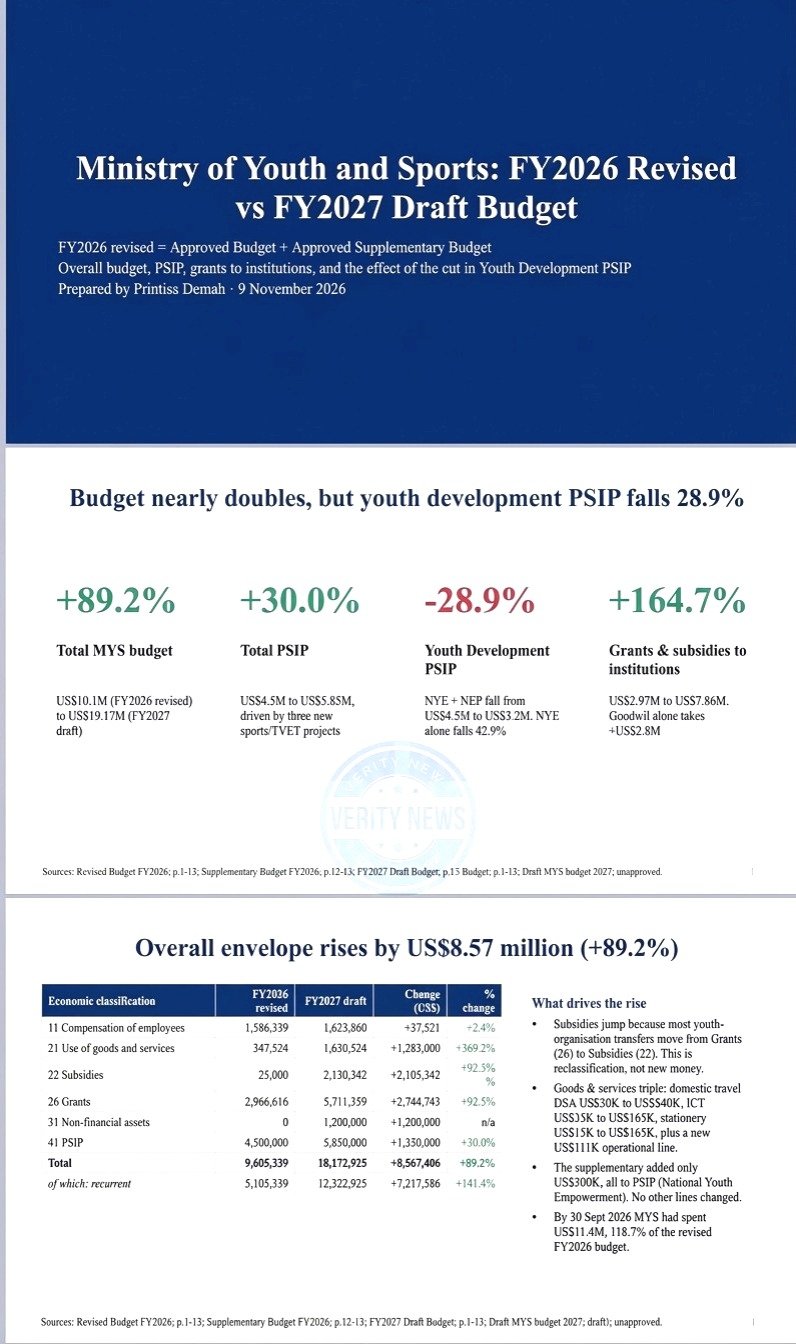
The Ministry of Youth and Sports (MYS) is seeking an 89.2 percent increase in its proposed FY2027 budget, rising from US$9.61 million in the revised FY2026 budget to US$18.17 million, despite a significant reduction in funding allocated to its core youth development programmes.
An analysis of the FY2027 Draft National Budget shows that much of the proposed increase is concentrated in grants and subsidies to institutions, rather than direct funding for youth development programmes.
Allocations for grants and subsidies are projected to increase from approximately US$2.97 million in FY2026 to US$7.86 million in FY2027, representing a 164.7 percent increase.
However, the proposed increase in institutional transfers comes alongside a 28.9 percent reduction in the Ministry’s Youth Development Public Sector Investment Programme (PSIP), which falls from US$4.5 million to US$3.2 million.
The National Youth Empowerment Programme, one of the Ministry’s major youth-focused interventions, faces an even steeper reduction, with its allocation dropping from US$3.5 million in the revised FY2026 budget to US$2 million in FY2027, representing a 42.9 percent decline.
The programme provides financial support for several youth-oriented interventions, including the National Cadet Program, vacation job opportunities, small-scale grants, and other empowerment activities designed to expand opportunities for young people. The proposed reduction therefore raises concerns about the potential impact on the reach and implementation of these programmes.
The National Empowerment Program, meanwhile, receives a modest increase from US$1 million to US$1.2 million.
Although the Ministry’s overall PSIP increases by 30 percent, reaching US$5.85 million, the additional funding is largely driven by three new projects:
US$1.5 million for the expansion and modernization of youth TVET facilities, US$650,000 for Lonestar Veterans’ sports development, and US$500,000 for inclusive sports and recreation services for youth.
The analysis further shows that institutional transfers are increasingly concentrated in sports-related bodies and facilities.
National Football receives the largest individual increase, rising from US$1.07 million to US$3.87 million, an additional US$2.8 million or 260.7 percent.
The Professional Sports Academy, which had no allocation in FY2026, is projected to receive US$437,000.
Sports bodies and facilities collectively receive an additional US$4.07 million, accounting for approximately 83 percent of the total increase in institutional grants and subsidies.
Meanwhile, youth organizations are projected to receive US$1.27 million, up from US$605,164, representing a 109.8 percent increase.
While the proposed budget reflects increased government support for several institutions, the declining allocation to the National Youth Empowerment Programme raises questions about the resources available for direct youth interventions, skills development, county-level programmes, and employment opportunities.
The budget analysis also indicates that the National Youth Empowerment Programme’s FY2027 allocation of US$2 million is substantially below its original FY2026 approved allocation of US$3 million, even after the supplementary budget raised it to US$3.5 million.
The figures present a critical question about the Ministry’s spending priorities: As its overall budget nearly doubles, how much of the additional funding will directly benefit young people through employment, empowerment, skills training, and development programmes?
The FY2027 figures remain proposed allocations contained in the draft national budget and are subject to legislative consideration and approval.