

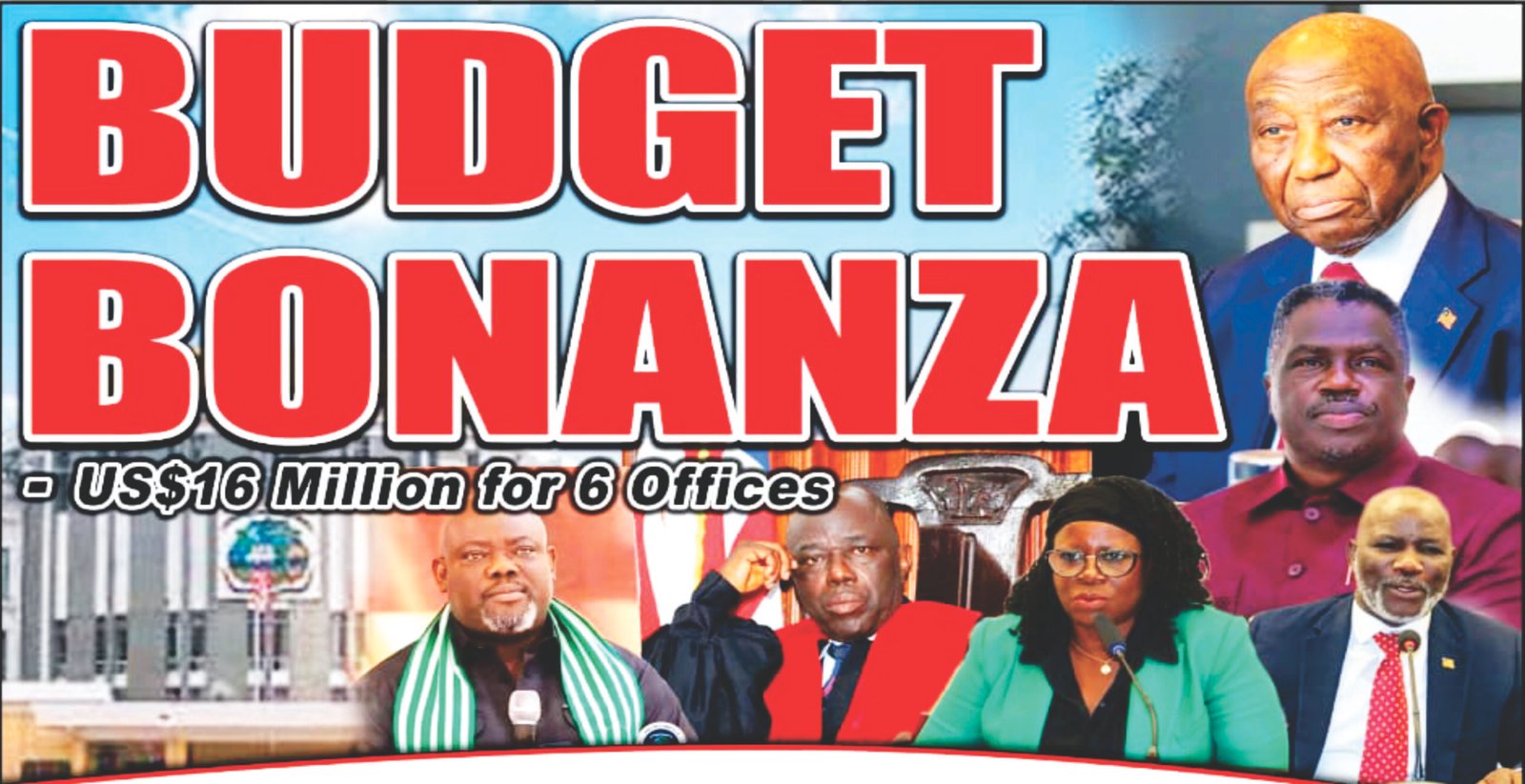
In a country ranked the 8th poorest in the world as of 2026, the cost of running the six highest public offices in Liberia has again increased to US$16.1 million in the FY2027 Draft Budget. The President’s allocation rises by 34.6%, the Vice President’s by 24.8%, while the Chief Justice’s surges by 172.3% amid high unemployment and underdevelopment.
An analysis of the FY2027 Draft Budget by Verity News shows that the combined allocations for the Offices of the President, Vice President, Senate Pro Tempore, Speaker, Deputy Speaker, and Chief Justice amount to US$16,119,562.
The amount represents an increase of US$2,931,962, or approximately 22.2 percent, compared with the US$13,187,600 approved for the same six offices in FY2026.
The figures reveal that the Office of the President is projected to receive US$4,469,571, up from US$3,319,571 in FY2026, representing an increase of US$1.15 million or 34.6 percent.
The Office of the Vice President follows with US$5,501,813, compared with US$4,409,153 previously, reflecting an increase of US$1,092,660 or 24.8 percent.
Combined, the two executive offices account for approximately 76.5 percent of the total increase allocated to the six offices.
However, the most significant percentage increase is recorded in the Office of the Chief Justice, whose proposed allocation rises from US$261,111 to US$711,111. This represents an increase of US$450,000, or approximately 172.3 percent.
Meanwhile, the Office of the Speaker is projected to receive US$2,189,156, an increase of US$91,156 or 4.3 percent.
The Senate Pro Tempore’s Office is allocated US$1,768,973, up by US$85,047 or 5.1 percent, while the Office of the Deputy Speaker increases to US$1,478,938 from US$1,415,839, representing a 4.5 percent rise.
AGRICULTURE MINISTRY RECEIVES LESS
Perhaps more concerning is the comparison between the allocations for the six high-ranking offices and the Ministry of Agriculture.
According to the FY2027 Draft Budget, the Ministry of Agriculture is allocated US$13,125,224, approximately US$2.99 million less than the combined budget of the six offices.
In other words, the proposed allocations for these six offices alone are approximately 22.8 percent higher than the entire allocation for the Ministry of Agriculture.
The Ministry’s allocation is expected to support its broader responsibilities, including agricultural development and efforts to strengthen food production.
The comparison raises questions about how the government is balancing administrative expenditure with investments in sectors that directly affect livelihoods, employment, food security, and economic development.
HEALTHCARE AND SOCIAL SERVICES
The budget figures also show varying allocations across major public healthcare institutions.
The John F. Kennedy Medical Center is allocated US$12.8 million, while New Redemption Hospital receives US$5.2 million and Jackson F. Doe Hospital is allocated US$4.88 million.
Phebe Hospital and School of Nursing receives approximately US$2.2 million, representing a reported one-percent increase from FY2026.
Beyond healthcare, the National Commission on Disabilities is allocated US$1.67 million, compared with approximately US$580,000 previously.
The National Disaster Management Agency receives US$2.56 million, while the Ministry of Gender, Children and Social Protection is allocated US$7.09 million.
The Kakata Rural Teacher Training allocation stands at US$1.37 million.
QUESTIONS OF PUBLIC SPENDING PRIORITIES
While the proposed increases may be defended as necessary to support the operations and responsibilities of the country’s highest constitutional and public offices, the figures invite broader scrutiny of whether public spending adequately reflects the pressing needs of ordinary Liberians.
With six offices receiving more than US$16 million in proposed allocations, questions remain about the justification for the increases, the expected outputs, and the level of accountability attached to these expenditures.
The 22.2-percent combined increase also raises questions about whether similar attention is being given to public hospitals, schools, agricultural development, rural infrastructure, and employment-generating programs.
As the FY2027 Draft National Budget moves through the legislative review process, lawmakers and relevant government institutions face the responsibility of explaining these allocations to the Liberian people.
For a population struggling with economic hardship and limited public services, the central question is not simply how much government intends to spend, but what measurable benefits citizens will receive from the money.