

By Archie Boan
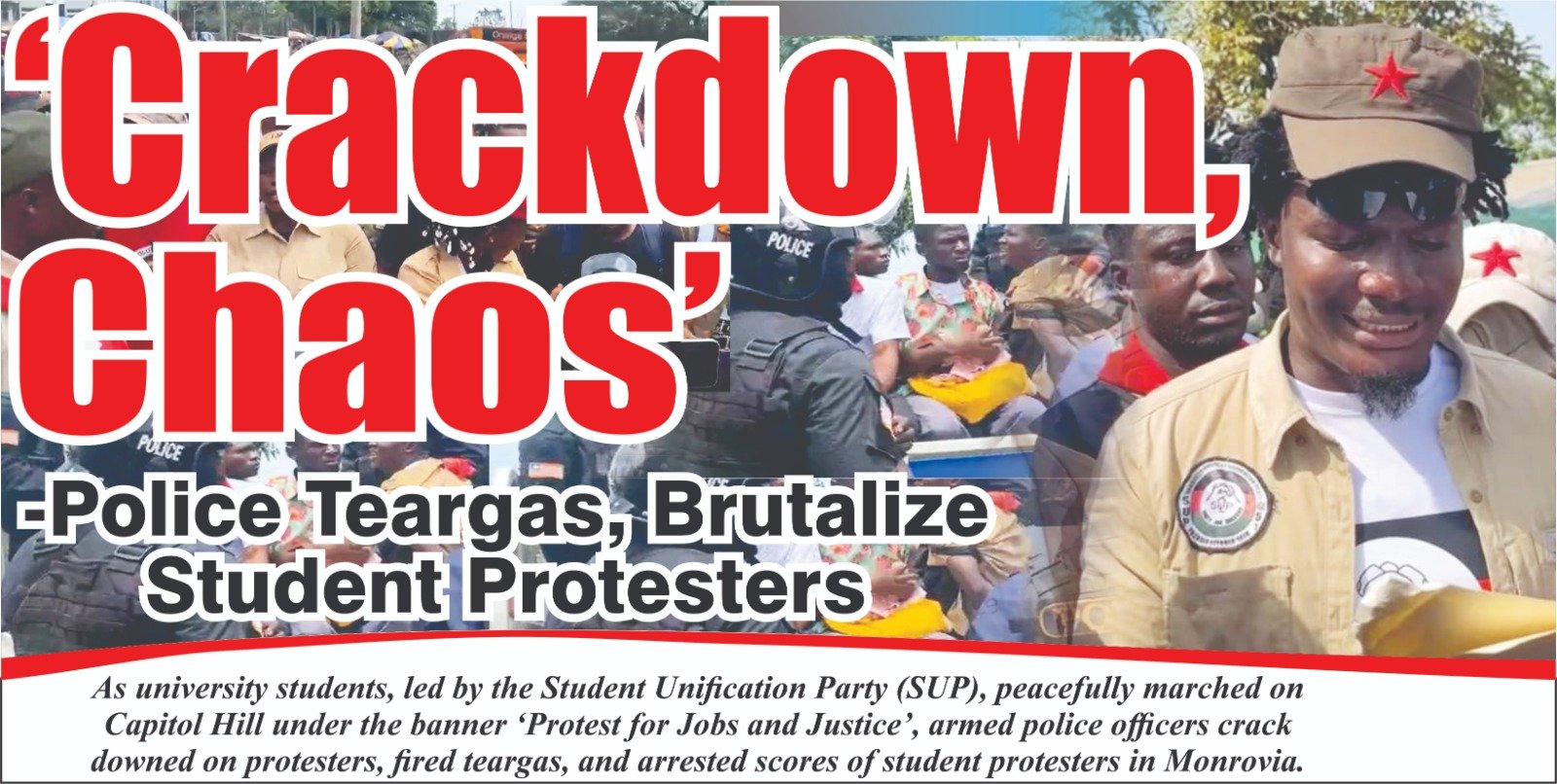
As university students, led by the Student Unification Party (SUP), peacefully marched on Capitol Hill under the banner “Protest for Jobs and Justice,” armed police officers cracked down on demonstrators, firing teargas and arresting scores of student protesters in Monrovia.
The confrontation unfolded Tuesday ( April 14, 2026) as hundreds of students, primarily from the University of Liberia, advanced toward Capitol Hill to present a petition outlining grievances over unemployment, economic hardship, and what they described as a deepening justice crisis in the country.
Eyewitnesses said officers of the Liberia National Police dispersed the crowd with teargas, triggering scenes of panic as protesters fled in different directions. Several students were reportedly beaten during the operation, while others were taken into custody. Authorities have yet to provide an official account of the incident.
Despite the disruption, regrouping demonstrators later converged near the United States Embassy in Monrovia, where leaders of the Student Unification Party successfully read and submitted their petition.
In the document addressed to President Joseph Nyuma Boakai and other top government officials, including Vice President Jeremiah Kpan Koung and House Speaker Richard Nagbe Koon, the students painted a grim picture of life for ordinary Liberians, particularly the youth.
The petition described widespread unemployment, poverty, and lack of opportunity as “excruciating,” noting that graduates and skilled young people continue to roam the streets in search of nonexistent jobs. It further cited high levels of undernourishment and child stunting as evidence of systemic national failure.
Framing their protest as more than a demonstration, SUP leaders called it “an articulation of unsettled grievances” and a response to what they termed the government’s persistent neglect of structural economic and governance challenges.
They questioned how Liberia, despite its vast natural resources, continues to struggle with poverty nearly two centuries after its founding.
Among key demands, the students called for a comprehensive employment program guaranteeing at least US$500 monthly salaries, the nationalization of major sectors of the economy, and a 50 percent reduction in salaries for top government officials to fund wage increases for civil servants.
They also urged increased budgetary support for agriculture in line with the Maputo Declaration, alongside reforms to strengthen accountability and justice.
The petition further demanded an end to alleged political interference in governance, protection for local businesses, and immediate investigations into reported cases of human rights abuses and sexual violence.
Notably, the students warned the government against continued “brutalization” of peaceful protesters, insisting that their actions are protected under Article 17 of the Liberian Constitution, which guarantees the right to peaceful assembly and petition.
The leadership of SUP emphasized that their movement remains committed to nonviolence but cautioned that failure by the government to act on their demands could trigger more forceful mass action.