


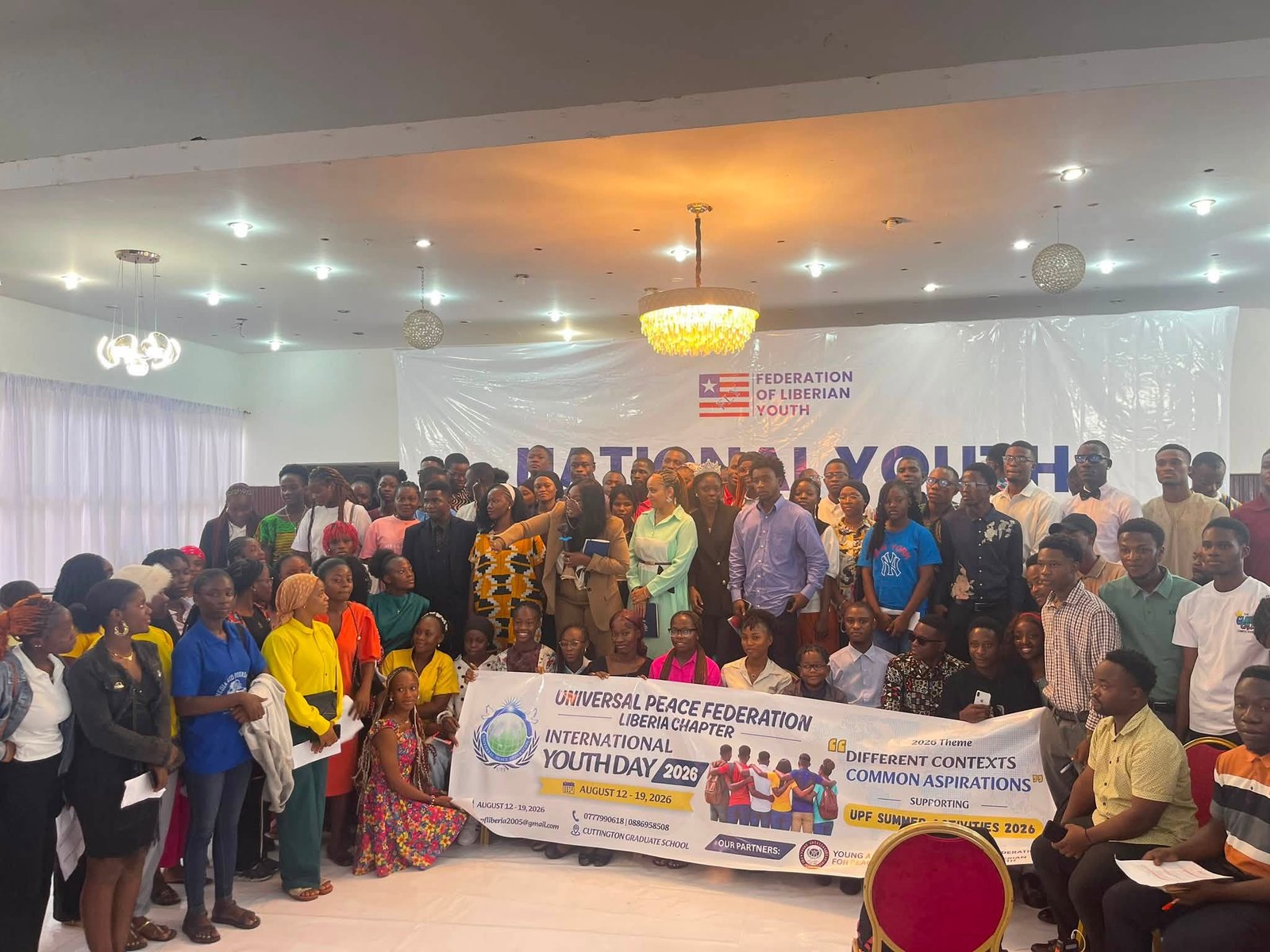
Federation of Liberian Youth (FLY) President Ernest Duku Jallah has challenged the Liberian government to abandon what he described as the long-standing practice of treating young people as “leaders of tomorrow” while excluding them from critical decisions affecting their lives today.
Jallah made the call Wednesday, August 12, 2026, during the National Youth-Government Dialogue held at Monrovia City Hall in observance of International Youth Day.
Addressing government representatives, partners and young Liberians, the FLY president said the country’s youth must no longer be viewed merely as beneficiaries of government programs or statistics used to project Liberia’s future.
“We are not asking government to make room for us. We are stating, plainly, that young people are already at the table and it is time the table’s business reflected that,” Jallah said.
He criticized the persistent narrative that young Liberians are the leaders of the future, arguing that such language often masks their exclusion from present-day policy and decision-making spaces.
Jallah said young people frequently hear about government decisions only after they have been made, despite being among the population groups most directly affected by those decisions.
He pointed to youth unemployment, mob violence, limited opportunities for graduates and growing distrust in public institutions as evidence of a deeper disconnect between young people and government.
“A generation graduating from school into no job, no pathway, no plan,” Jallah said, warning that the challenges confronting young Liberians cannot continue to be addressed through isolated interventions.
According to him, the problems are interconnected and largely stem from what he called a “broken relationship” between young people and the institutions established to serve them.
“None of these are separate problems. They are one problem, wearing different faces: a broken relationship between young people and the institutions meant to serve them,” he said.
Jallah stressed that Wednesday’s gathering should not become another ceremonial youth engagement where government officials listen to concerns, make promises and return to business as usual.
“This is not a listening session where young people speak and government nods politely before returning to business as usual. This is a working session,” he declared.
The dialogue brought government and young people together for direct engagement, with the National Road Fund of Liberia (NRFL) serving as the focus institution for the inaugural session.
The NRFL boss served as a panelist during the dialogue, participating in discussions about the gaps between young people and the institution and how the National Road Fund could better respond to the needs of young Liberians.
Jallah said the National Road Fund was an important starting point because decisions concerning roads directly affect young people’s access to education, markets, healthcare, jobs and economic opportunities.
He called for concrete commitments from both government institutions and young people, insisting that future engagements should be measured by what is actually delivered.
“Not another communiqué. Not another photo. Commitments, with names attached and dates attached commitments we will hold each other to, publicly, starting the next time we meet,” Jallah said.
The FLY president said Liberia’s development cannot be achieved if young people remain on the margins of governance.
He called for structured and sustained dialogue between government and young people, arguing that regular engagement could help rebuild trust and address some of the country’s persistent social challenges.
Jallah said the Federation of Liberian Youth represents young people across all 15 counties, including students, farmers, market women’s sons and daughters, first-generation graduates, peacebuilders and other young Liberians.
He maintained that their voices should be incorporated into policymaking rather than being sought only during elections, public campaigns or national celebrations.
“When young people do not trust government, and government does not systematically listen to young people, every other crisis we name has fertile ground to grow in,” he warned.
He further urged government representatives to view their participation in the dialogue as more than attendance at an event.
“To our partners in government here today: thank you for choosing to show up, and to stay in the room. That choice matters more than any speech,” Jallah said.
He also encouraged young Liberians to take ownership of the process, insisting that their participation must extend beyond speaking at dialogue events to holding institutions accountable for commitments made.
Jallah concluded by arguing that Liberia’s future must be built through a partnership between government and its youthful population.
“Liberia’s future will not be built by government alone, and it will not be built by young people shouting from outside the gate. It will be built in rooms exactly like this one where trust is not assumed, but earned, one honest conversation and one kept promise at a time,” he said.