
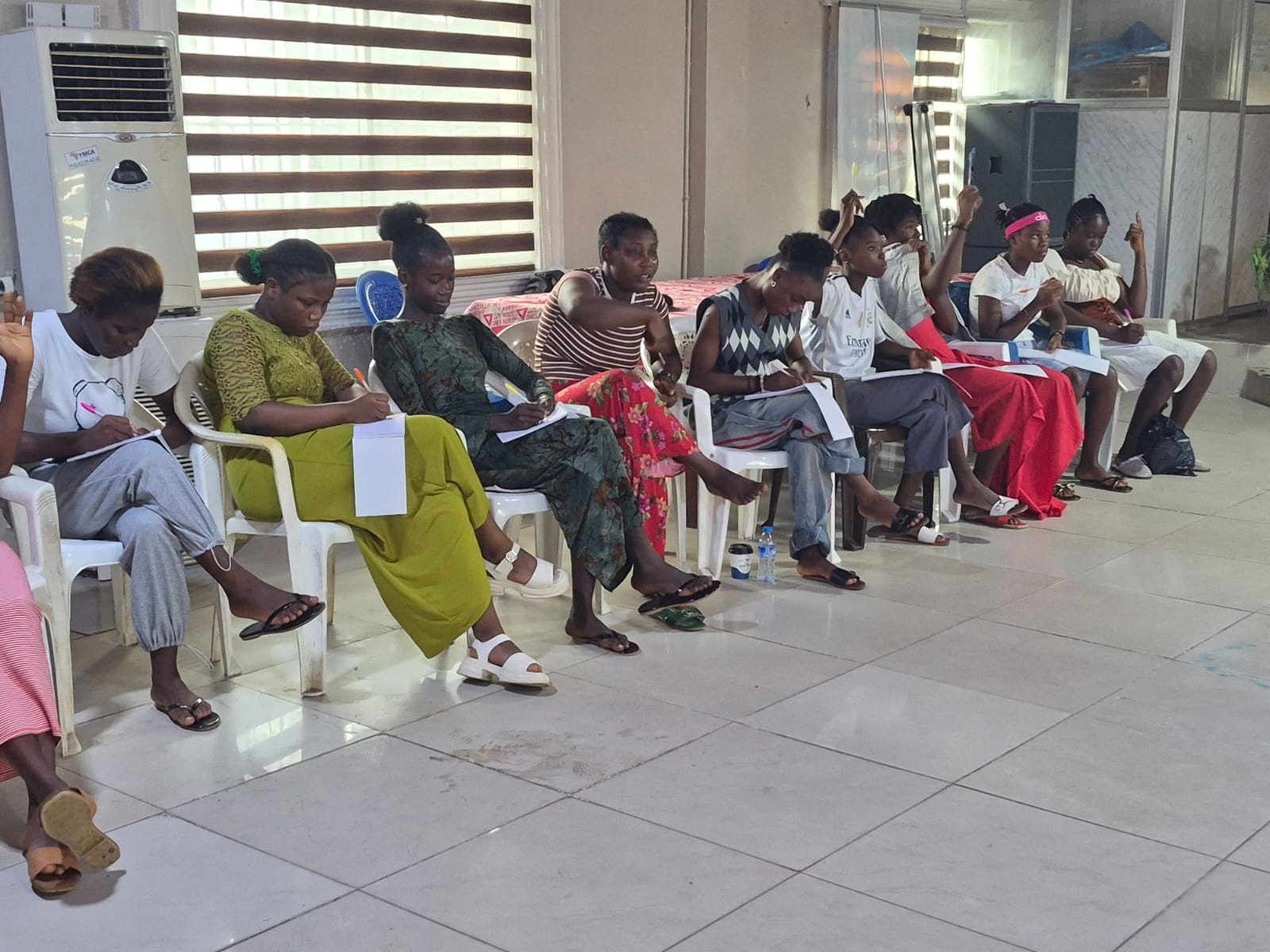
Maxine Lussine didn’t expect two men to run her group session that day. Her usual facilitator, Ms. Juwa, was gone. In her place stood Jerome Naa Wlalee and a colleague.
“They started talking about how boys also have a part to play in menstruation,” said the 17-year-old from Old Road, a member of a peer support group under Healing Bridge Liberia. “For our setting, where I grew up, I’ve never seen my dad really taking part in menstruation and all that. So it was really confusing to me, because those are things I’ve seen in movies.”
That confusion is the wall Healing Bridge is trying to knock down. In Liberia, periods, sex, and reproductive health have long been treated as women’s business; fathers, brothers, and boyfriends stay out of. Healing Bridge’s leadership believes that silence helps explain why teenage pregnancy has stayed stubbornly high for decades. Liberia’s 2029/2020 demographic and health survey found 32 percent of girls aged 15 to 19 are already pregnant or mothers, and adolescent girls make up 60 percent of the country’s obstetric fistula cases.
The day it happened, Maxine Lussine remembers being caught off guard. Their usual facilitator, a woman the girls called Ms. Juwa, wasn’t there. In her place stood two men, Jerome Naa Wlalee and a colleague, ready to lead the session anyway. What came next stayed with her.
“They started talking about how boys also have a part to play in menstruation,” said the 17-year-old from Old Road community, who is part of a peer support group under Healing Bridge Liberia. “For our setting, where I grew up, I’ve never seen my dad really taking part in menstruation and all that. So it was really confusing to me, because those are things I’ve seen in movies.”
That confusion is exactly the barrier Healing Bridge is trying to break down. In Liberia, conversations about periods, sex, and reproductive health have long been treated as women’s business, something fathers, brothers, and boyfriends stay out of. Healing Bridge’s leadership argues that silence is part of why teenage pregnancy has stayed stubbornly high for decades. According to Liberia’s 2029/2020 demographic and health survey, 32 percent of girls between 15 and 19 are already pregnant, or mothers, and adolescent girls account for 60 percent of the country’s obstetric fistula cases.
The program is part of the Nurture, Empower, and Protect (NEP) project, a five-year, €7 million initiative funded by the Embassy of Ireland and jointly run by UNICEF and UNFPA, targeting more than 107,000 adolescent girls across Montserrado, Grand Gedeh, and Rivercess counties by 2030. Healing Bridge is one of the community organizations selected by the Clinton Health Access Initiative to carry that work into five communities: Old Road, Clara Town, Slipway, PHP Community, and West Point.
But unlike many reproductive health programs that focus only on girls, Healing Bridge built men and boys into the design from the start. Niagulali, the organization’s executive director, said trained male volunteers don’t wait for people to come to them. They go out looking for conversation. “They met people at the attire shop, at the market, the seaside, the fishermen, all of those different places,” he said, describing informal dialogue sessions the volunteers hold in daily gathering spots around the five communities. “They did everything. It was very, very good.”
The goal, Wlalee said, is to shift what he calls a generational habit of silence, one where fathers avoid the subject entirely and mothers are left to explain everything alone, often too late or too vaguely to matter. “We also engage men and boys because they too need to get involved with this entire empowerment stuff as well,” he said.
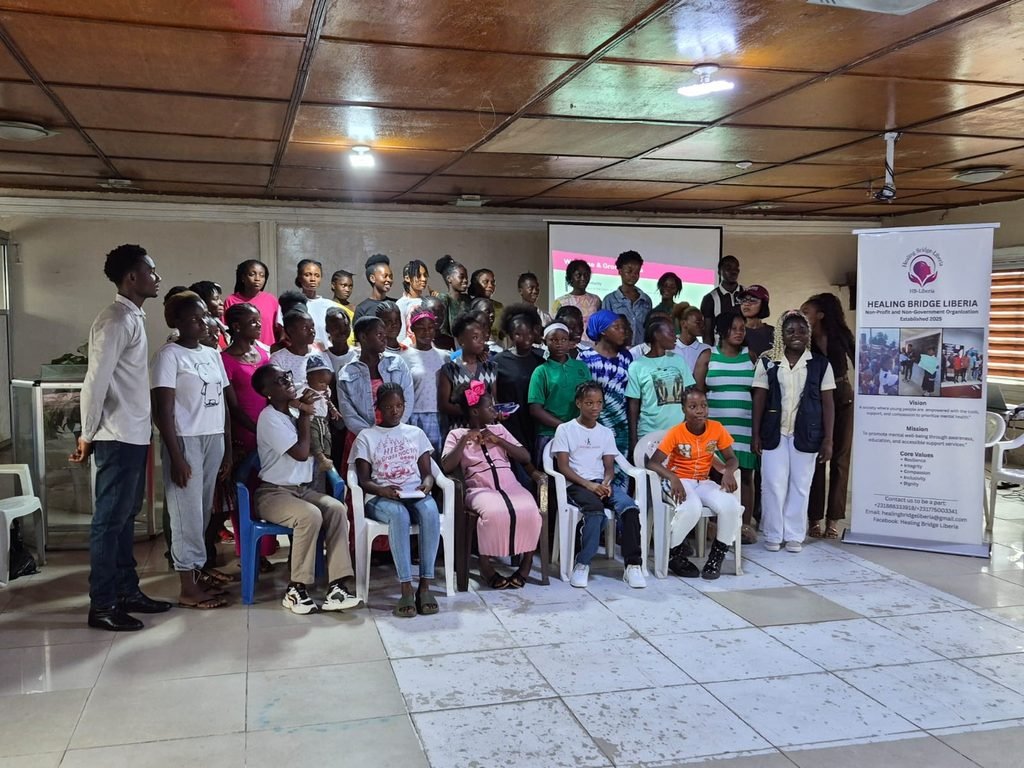
Members of Healing Bridge Liberia’s peer support groups gather for a group photo at a graduation event under the Nurture, Empower, and Protect (NEP) project, which brings boys and men into conversations once treated as women-only.
For Maxine, the lesson went further than menstruation. It reshaped how she understood her own authority over her body. “They told me that I have the final say concerning my body,” she said, describing a separate session on consent. “My yes, me yes. My no, me no.” She said she now feels she can turn to her own mother with questions she once would have kept to herself, something she credits partly to watching men in the program speak openly about a subject she’d always been taught was off-limits to them.
Wlalee is candid that shifting an entire community’s habits doesn’t happen in one workshop, or even one graduating class of 25 girls. Healing Bridge is now restructuring its model into shorter, rolling cohorts so it can reach more communities faster, aware that the wider NEP project’s targets are enormous compared to what one organization can do alone. But he points to the male volunteers’ reports and the testimonies coming back from caregivers as early proof that something is moving. “Some participants gave testimonies that they now can talk to their parents about certain things,” he said. “It’s not more like a taboo anymore.”
He said for a program built on the idea that girls should not be treated only as beneficiaries but as agents of change in their own communities, getting boys and men into that same conversation may be one of the quieter, but more lasting, shifts underway in Monrovia’s slums.