


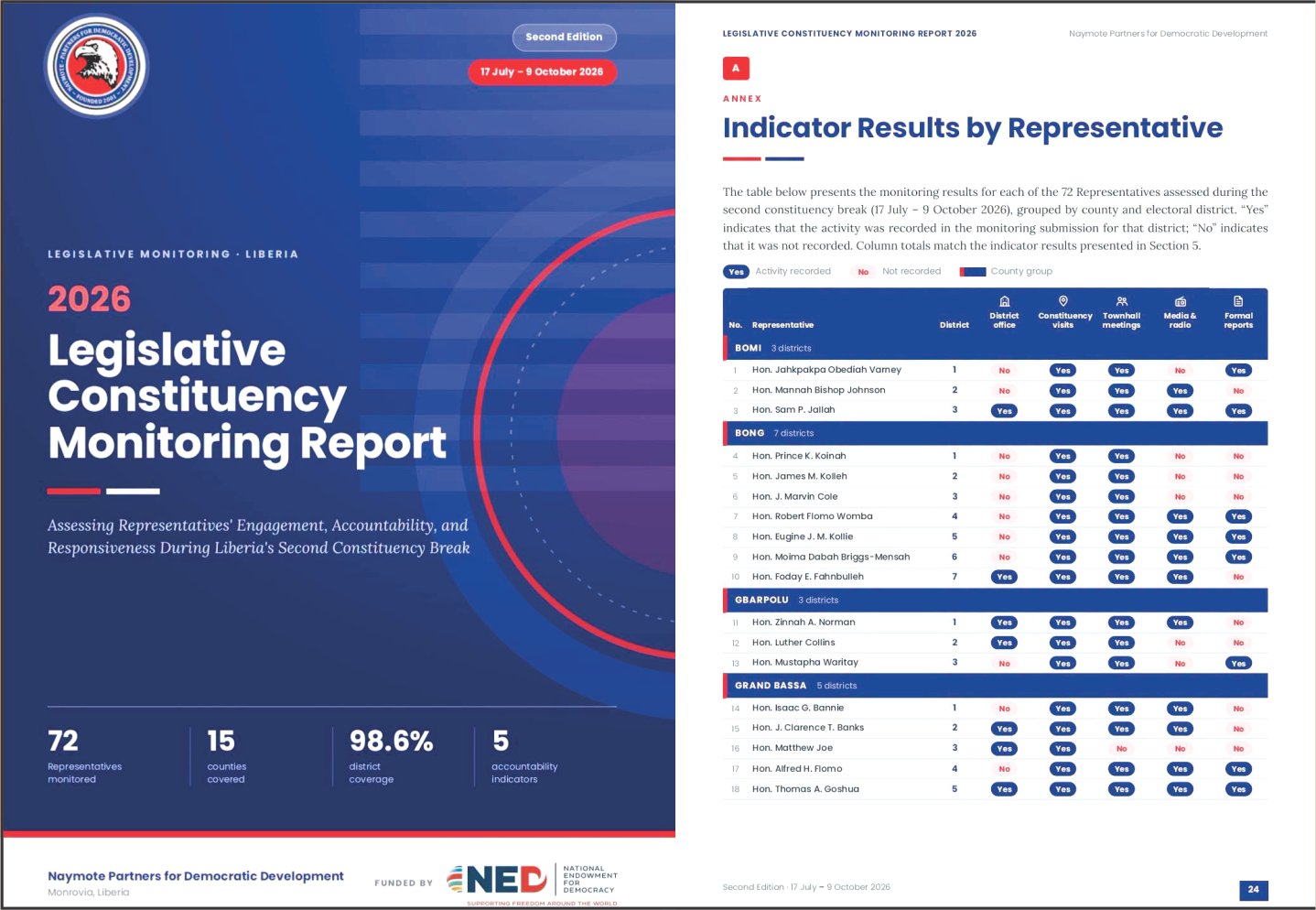
A new legislative monitoring report by Naymote Partners for Democratic Development has exposed significant accountability and accessibility gaps among Liberia’s lawmakers, revealing that half of the 72 Representatives monitored failed to provide formal legislative reports or constituency updates during the second constituency break of 2026.
The report, covering the period July 17 to October 9, 2026, also found that 27 Representatives, representing 37.5 percent of those monitored, had no functional district offices, raising concerns about citizens’ ability to consistently access their elected officials.
Released as the second edition of Naymote’s Legislative Constituency Monitoring Report, the assessment covered 72 of Liberia’s 73 electoral districts across all 15 counties, representing 98.6 percent national district coverage.
According to the findings, only 36 Representatives (50 percent) provided formal legislative reports or updates to their constituents, while the remaining 36 had no documented reports during the monitoring period.
The report identified formal legislative reporting as the weakest of five accountability indicators assessed, suggesting that despite visible constituency activities, many lawmakers are not consistently documenting and communicating their legislative work, decisions, commitments, and progress to citizens.
On constituency accessibility, the assessment found that 45 Representatives (62.5 percent) had functional district offices, while 27 (37.5 percent) did not.
The findings suggest that a considerable number of constituents may lack reliable institutional channels to submit concerns, request assistance, obtain information, and follow up on commitments made by their elected representatives.
However, lawmakers recorded stronger performance in physical constituency engagement.
Sixty-six Representatives, representing 91.7 percent, reportedly visited their constituencies during the monitoring period, making constituency visits the strongest-performing indicator.
Additionally, 56 lawmakers (77.8 percent) reportedly organized townhall meetings or public consultations, while 51 (70.8 percent) participated in radio or other media engagements.
Despite the relatively high number of reported townhall meetings, Naymote identified weaknesses in the regularity of consultations, inclusiveness, documentation of discussions, and follow-up mechanisms for commitments made to citizens.
The report further observed that some constituency activities centered on donations, project dedications, community ceremonies, Independence Day celebrations, and political networking, which may enhance lawmakers’ visibility but often provide limited opportunities for substantive policy discussions, public scrutiny, and accountability.
It stressed that physical presence in constituencies does not necessarily translate into effective representation or measurable results.
Among the major concerns raised by citizens during consultations were poor road conditions, inadequate educational and healthcare facilities, limited youth employment opportunities, and challenges relating to peacebuilding and community cohesion.
Naymote is recommending that Representatives institutionalize public reporting after every constituency break, maintain functional district offices, publish engagement schedules, and establish public registers to track commitments, responsible institutions, deadlines, and progress.
The organization is also urging House leadership, lawmakers, and civil society institutions to develop measurable constituency accountability standards supported by consistent monitoring and evidence-based reporting.
The report cautioned that its findings measure recorded constituency engagement and accountability practices rather than the overall legislative effectiveness of individual lawmakers or the long-term impact of their activities.
Nevertheless, it presents a significant picture of the state of constituency representation in Liberia, highlighting the gap between lawmakers’ physical engagement with citizens and their responsibility to provide documented accounts of their legislative activities.