
By Verity News Investigative Team
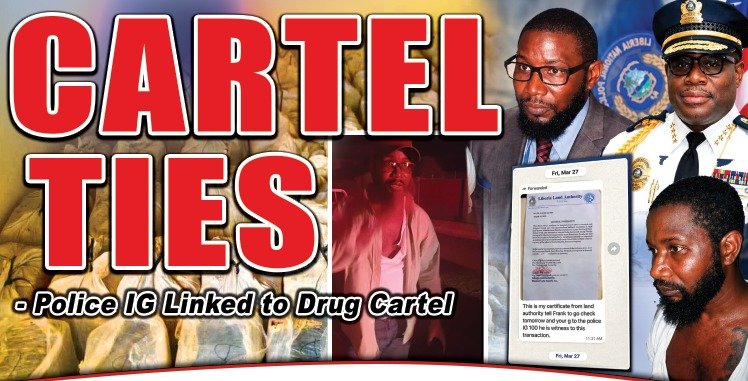
An investigation by Verity News has obtained a WhatsApp message involving Gerald F. Smith, a leading suspect in the US$317 million drug investigation whom the government has identified as a person of interest, raising questions about his reported relationship with Police Inspector General Gregory O. W. Coleman.
The message, attributed to Smith, refers to Coleman in connection with a land transaction. It states: “This is my certificate from land authority. Tell Frank to go check tomorrow and your go to the police IG 100. He is a witness to this transaction.”
The message does not establish that Coleman was involved in drug trafficking. But coming at a time when Smith is under investigation, the reference to the Police Inspector General raises questions about the nature of their relationship and whether Coleman should have any role in an investigation involving Smith.
The government has identified Smith as a person of interest in the investigation into an alleged international narcotics network. The former Deputy Director of the National Security Agency (NSA) for Administration has been called in for questioning.
The Ministry of Justice has also announced charges in absentia against Croatian nationals Nikolai Ivancic and Mihovil Vrovac and Ukrainian national Tara Zaderieko, whom the government alleges are members or organizers of the same transnational narcotics network.
The government says it intends to pursue the suspects through both domestic and international channels and has vowed to identify the alleged financiers, facilitators, transporters and others who may have helped the network operate.
Questions over Coleman-Smith relationship
The investigation has raised a second question that could prove important: who should investigate Gerald Smith?
In his “From Where I Sit” commentary, writer Philipbert Semogai Jabba-Wleh Browne argues that the Liberia National Police may not be the right institution to handle the matter if Coleman remains directly involved.
Browne claims Smith and Coleman have a close relationship, alleging that the two communicate frequently and that Smith was regularly seen at the Inspector General’s office.
He therefore called on Coleman to step aside from any investigation involving Smith and urged that the case be handled by an independent or neutral body.
The concern is straightforward. Even where no wrongdoing has been established, an investigation can lose public confidence if the investigator is seen as being too close to the person under investigation.
There is, however, no court finding that Coleman has participated in drug trafficking or protected Smith from investigation.
The unanswered Floko’s Town questions
Browne has also called for Smith to explain what he knows about a 2023 incident involving a large airboat that allegedly landed at Floko’s Town, on property belonging to former Liberian Ambassador to Morocco Archie Richlue Williams.
According to the account, three foreign men arrived aboard the vessel and allegedly unloaded goods at night while armed Liberian security personnel were present.
Browne alleges that Smith and the then Inspector General of Police were among senior security officials who went to the property that night.
Residents were reportedly told that former President George Manneh Weah was expected at the residence and that they had to leave for security reasons.
The allegations raise several questions. What was brought ashore? Who authorized the operation? Why residents were allegedly kept away from the beach for months? And why did the foreign men reportedly remain at the property under heavy security?
Browne further alleges that the boat repeatedly went to sea and returned with goods that were unloaded at night before the vessel and its occupants disappeared around January 2024.
These claims have not been independently verified. No court finding cited in the material establishes that the boat carried narcotics or that Smith, Coleman or any other named official was involved in an illegal operation.
A troubled chapter at the NSA
The allegations also reopen questions about the National Security Agency during the Weah administration.
James Henric Pearson II was director of the NSA, while Sam Sayon and Gerald Smith served as deputy directors.
Accounts from the period describe serious disagreements within the agency. Critics later referred to the period as the NSA’s “Dark Days,” arguing that the divisions weakened the institution and damaged public confidence.
A 2019 incident involving Smith and the security detail of then-Vice President Jewel Howard Taylor further exposed tensions within the security establishment. Smith was reportedly disarmed following an altercation at Taylor’s residence.
The material reviewed by Verity News does not contain a public audit establishing that NSA officials misused agency funds during that period. It also does not establish through a court ruling that NSA officials facilitated drug trafficking.
Liberia’s drug problem
The controversy comes as Liberia faces renewed pressure over the growing presence of international drug networks.
In October 2022, authorities seized about 520 kilograms of cocaine at the Freeport of Monrovia, with the shipment valued at approximately US$100 million.
The case ended in a jury acquittal in May 2023. The defendants were later released and fled the country.
Another major cocaine seizure at Roberts International Airport in 2026 has added to concerns that Liberia is being targeted as a transit point for international drug traffickers operating through West Africa.
The cases have also exposed weaknesses in Liberia’s ability to investigate and prosecute sophisticated international narcotics operations.
Alleged plots against security officials
The report further examines allegations that international drug cartels plotted against former NSA Director Fumba Sirleaf and former Liberia Civil Aviation Authority Managing Director Archie Williams.
The alleged plots were reportedly linked to their involvement in an international investigation targeting suspected cartel operatives.
According to the account, a Zambian national was arrested in Liberia during a joint operation involving Liberian and U.S. authorities and later extradited to the United States.
Two German nationals were also reportedly intercepted at Roberts International Airport in a separate operation and taken to the United States.
The cases are cited as examples of how cooperation between Liberian and U.S. authorities helped disrupt alleged threats against Liberian officials.
The most important question now is whether the US$317 million drug investigation will go beyond arrests and charges and expose the full structure of the alleged network.
That means determining who supplied the money, who moved the drugs, who provided logistics and, if the evidence supports it, whether anyone inside Liberia’s security or political establishment provided protection.
For that reason, the relationship between Gerald Smith and senior security officials deserves close scrutiny.
But scrutiny must be matched by evidence.
As the investigation moves forward, Liberians will expect the government to show that no one—regardless of position, influence or connections-is beyond investigation, while ensuring that those accused are given due process and that allegations are tested against evidence in court.