


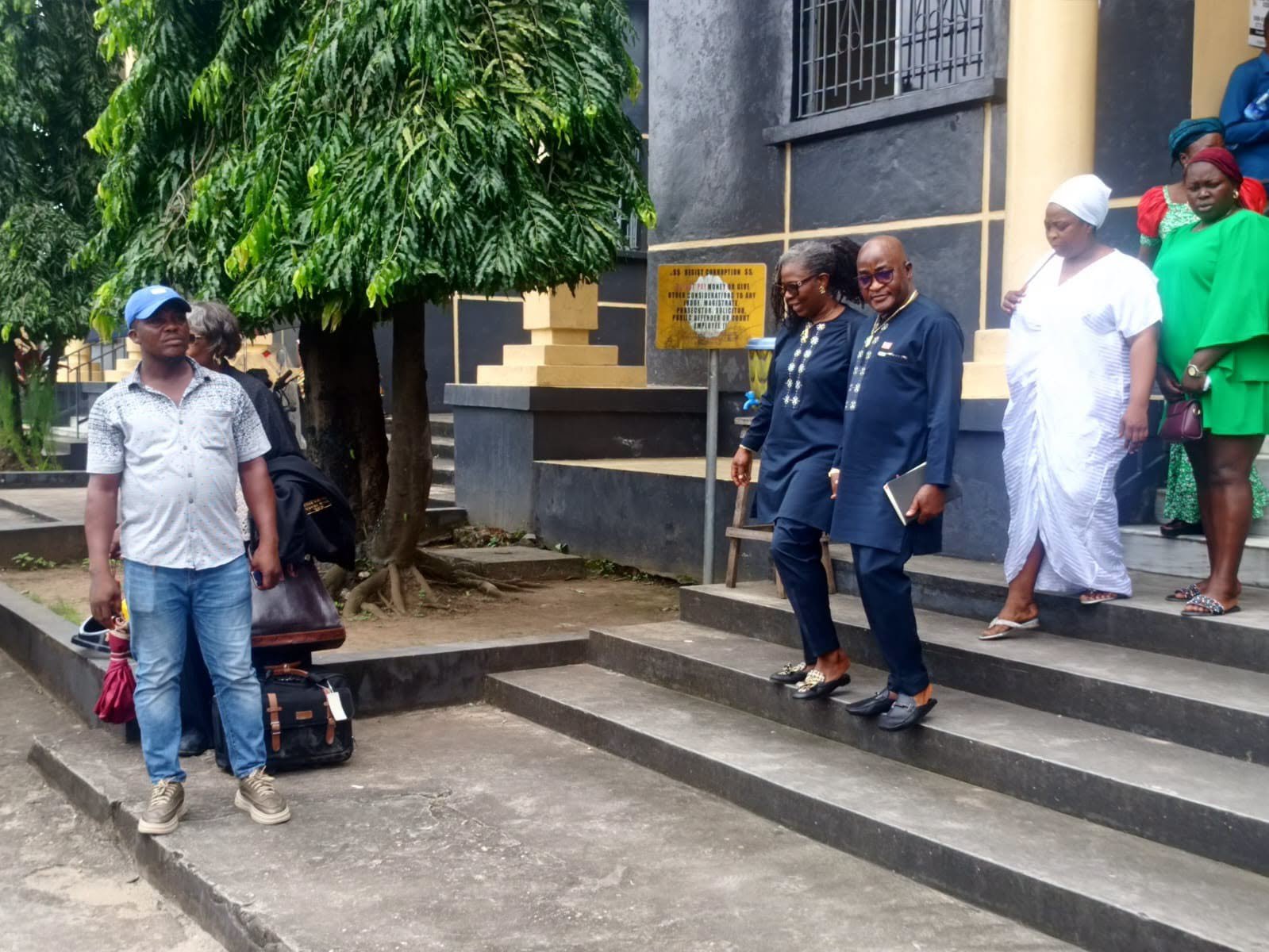
The defense in the Saudi rice trial has told Criminal Court “C” that 150 bags of rice were donated to the family of the late Angel Tokpah, but video evidence presented in court did not show the family receiving the rice.
Archievigo Doe, Communications Director of the National Disaster Management Agency (NDMA), made the claim Monday, September 21, 2026, while testifying as the second defense witness.
Doe is also a defendant in the case. Prosecutors have accused him of signing for 250 bags of Saudi rice that they say cannot be accounted for.
According to the concept note for the Saudi rice donation, each family affected by a disaster was to receive two bags of rice.
The defense presented video footage showing former NDMA Executive Director Henry O. Williams speaking about the Saudi rice donation on September 19, 2023.
But the footage shown in court did not show the alleged delivery of 150 bags to the Tokpah family.
Doe told the court that a video showing Prof. Williams with mattresses and bags of rice was from the donation to the Tokpah family.
“The first video which Prof. Williams is seeing talking with mattresses and bags of rice was the one that was captured in the Tokpah Family donation,” Doe testified.
He also complained about the questions asked during his appearance before the Assets Recovery and Property Retrieval Taskforce investigation.
“During my appearance at ARREPT, there was no questions about Caldwell. All of the 18 questions, three were about Chicken Soup Factory,” Doe said.
“I didn’t know what to produce because they didn’t show me anything,” he added.
Jurors Question Rice Donation
During questioning by the jurors, Doe was asked about 50 bags of Saudi rice he said were given to Faith-Based Academy.
Juror J30-10609 asked how the donation addressed flooding at the school when, according to the question, the school had not been cooking for its students.
Doe said the school normally cooked for its daycare students and that the rice was meant to help with that effort.
“My understanding is that, the school used to cook everyday for the daycare students. I also understand that the school collects 100 LRD from the children to cook everyday; as such, the donation was intended to buttress the effort of the school,” he said.
Asked how the NDMA determined the amount of rice to give during an emergency, Doe said the agency first assessed the situation.
“Whenever a situation occurred, the risk management team do an assessment to know the gravity,” he said. “We do have a threshold for donations based on the magnitude.”
Doe said the NDMA had videos and photographs from several donation activities.
“There are several videos and pictures covering most of NDMA activities of donations. I presented the video and newspaper because I was indicted specifically of stealing the 150 bags of Saudi Rice,” he intimated.
He said his work on the Saudi rice project went beyond taking a team to Faith Care Elementary School.
“My role in the Saudi Rice project was not only leading the team to the Faith Care Elementary School, but there were other roles I played during the donation,” Doe testified.
Doe Questions ARREPT Investigation
Under questioning from Judge Ousman F. Feika, Doe also spoke about his interaction with ARREPT investigators concerning the Chicken Soup Factory.
“ARREPT asked me a specific question about my role in Chicken Soup Factory,” he said.
“We have had different projects in Chicken Soup Factory; two years after, in my response, I told ARREPT that I needed a specific paper to respond to and ARREPT told me that they would have gotten back to me. They didn’t get back to me until this day,” Doe testified.
The court later asked whether information about the donations to the Chicken Soup Factory and the Tokpah family was relevant.
Doe said information about all Saudi rice distributions was important.
“Every information regarding the Saudi Rice project is important. Either me or my staff were almost at every distribution or delivery site,” he said.
Doe said he would have provided information about the two donations if investigators had shown him the relevant documents.
“I wouldn’t have remember about the delivery at the Chicken Soup and the Tokpah Family. If only these two bill were presented to me, I would have responded to ARREPT,” he said.
“The Tokpah Family is there, the video is also and the administrators of the school are also available. Why wouldn’t I shared these information with the investigation?” Doe added.
The defense is continuing to present its witnesses as the trial over the distribution and accountability of Saudi-donated rice proceeds at Criminal Court “C.”