

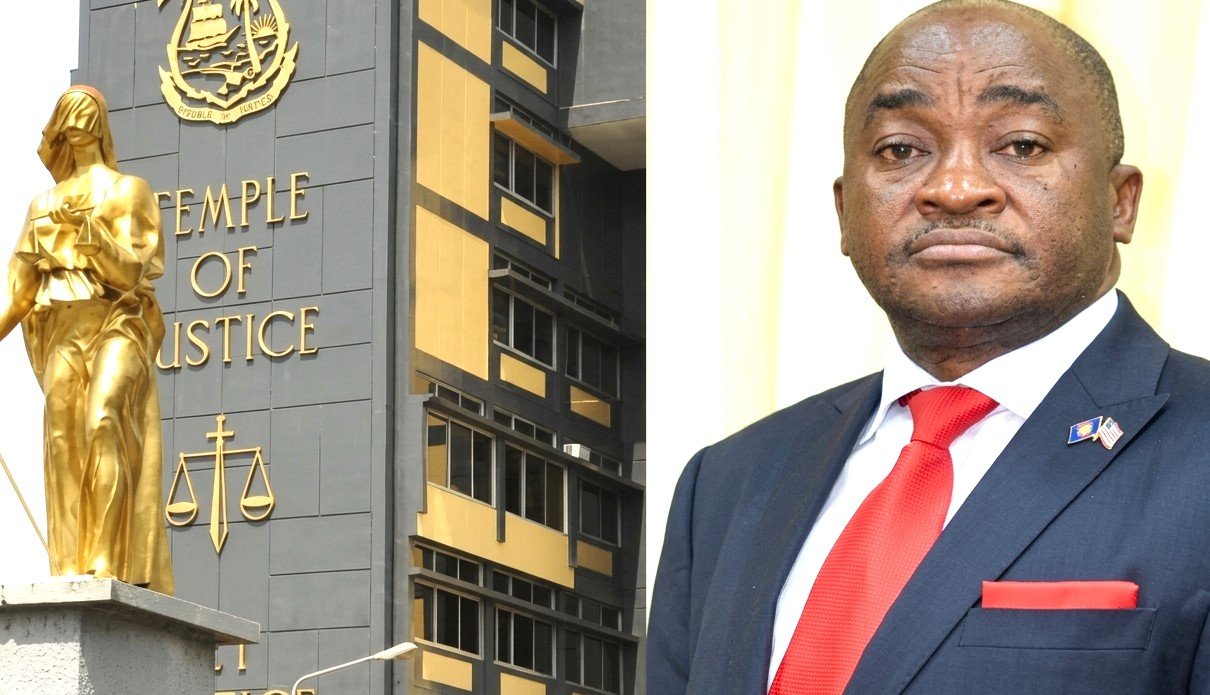
Former Foreign Minister Dee-Maxwell Saah Kemayah says the Ministry of Foreign Affairs played no part in purchasing or distributing the Saudi-donated rice.
But parts of his own testimony before Criminal Assizes C show that the ministry was involved in communicating Liberia’s rice requirements to Saudi Arabia, receiving information about the selected supplier, monitoring the donation and answering to Saudi authorities about the rice.
“The MFA under my watch at the time will not get involved in the purchase of rice,” Kemayah told the court.
He said the Saudi government handled the bidding process itself, “absolutely void of the MFA as an institution and me though as a minister and individual.”
Kemayah, however, acknowledged that the MFA contacted the Ministry of Agriculture to obtain information on the type and specifications of rice Liberia needed.
He said the information was then sent to Saudi Arabia through Liberia’s embassy.
According to Kemayah, Saudi officials later informed the MFA about the company selected to supply the rice and introduced the company to the ministry.
He also testified that the MFA had a responsibility to monitor the project after the rice arrived.
“Anything that goes wrong with the rice, it is MFA that the Saudi will contact,” he said.
Kemayah added that the ministry was responsible for accounting to the Saudi government for the rice.
DISTRIBUTION WAS NDMA’S JOB, KEMAYAH SAYS
Despite the MFA’s involvement in the diplomatic and monitoring aspects of the donation, Kemayah maintained that the National Disaster Management Agency was responsible for distributing the rice.
He strongly denied ever taking part in the distribution.
“At no time whether in my dreams or real life I ever participated directly or indirectly in the distribution of any gran of the Saudi donated rice,” he testified.
“I never ever recommended or authorized the distribution for a grain of rice to anyone.”
Kemayah, however, acknowledged that he intervened after receiving information about problems involving the rice.
He said he contacted NDMA Board Chairman Varney Sirleaf and former GSA Director-General Mary T. Broh.
He said representatives of the MFA, Ministry of Internal Affairs, GSA and NDMA later met to assess the situation.
‘RESCUE THE RICE’
Kemayah was also questioned about Broh’s earlier testimony that his intervention was intended to “rescue the rice.”
He clarified that he was referring to what Broh had told the court and was not claiming that she had used those exact words in a conversation with him.
The issue became important during cross-examination as prosecutors sought to establish the extent of Kemayah’s involvement after concerns arose over the handling of the donation.
WAS THERE AN ‘ALARM’?
Kemayah’s testimony also raised questions over whether officials had received an alarm about the rice.
He said he received information about alleged wrongdoing in the distribution process and contacted officials to find out what was happening.
But he later told the court that “there was no alarm with respect to rice.”
A prosecution question suggesting that a committee had been formed because of an alarm that the rice was being sold on the market was objected to, and the court sustained the objection.
MEETINGS UNDER QUESTION
Kemayah also faced questions about meetings between the MFA and NDMA.
He said meetings held before the rice arrived were necessary to prepare for its delivery.
But he described meetings held after the rice arrived—including discussions about protecting the rice and getting it to intended beneficiaries—as an “usurpation of function.”
Prosecutors questioned why such meetings were acceptable before the rice arrived but became an alleged usurpation after delivery.
Kemayah maintained that NDMA remained responsible for distribution until the end of former Executive Director Henry O. Williams’ tenure.
THE CASE
The trial centers on the handling of rice donated to Liberia by the government of Saudi Arabia.
Prosecutors allege that thousands of bags of the donated rice were improperly handled, transferred or diverted.
The defendants face charges including theft of property, economic sabotage, misuse of public money, property or records, illegal disbursement or expenditure of public money, misapplication of entrusted property, abuse of office and criminal conspiracy.
The defendants have pleaded not guilty and remain presumed innocent unless the prosecution proves the charges against them beyond a reasonable doubt.
The case has involved former officials of the Ministry of Foreign Affairs, Ministry of Internal Affairs, NDMA and GSA, including Kemayah, Varney Sirleaf, Thelma Duncan Sawyer, Momolu Johnson, Henry O. Williams, Edris Bility and others.
Former GSA Director-General Mary T. Broh, who also testified during the proceedings, is no longer a defendant after the prosecution entered a nolle prosequi in her case.
RICE TRANSFER REMAINS DISPUTED
One of the major issues in the trial is the movement of thousands of bags of rice from NDMA facilities to GSA warehouses.
The prosecution has questioned the authority for the transfers and the subsequent distribution of the rice.
The defense has maintained that the transfers were carried out because of concerns over storage and inventory and were intended to protect the donation.
Former GSA official Edris Bility testified that gate passes accounted for 5,000 bags reportedly sent to the Gbarnga Regional Hub.
He said the documents were signed by GSA warehouse staff, security personnel, an NDMA representative and the drivers involved.
The competing accounts have left the court to determine who authorized the movement of the rice, why it was moved and whether any defendant acted outside his or her legal authority.
WHAT THE COURT MUST DECIDE
Kemayah’s testimony does not by itself prove that he personally distributed, diverted or misappropriated any of the Saudi-donated rice.
But his evidence has provided the court with a clearer picture of the MFA’s involvement in the donation and its dealings with Saudi authorities.
The prosecution and defense have presented oral and documentary evidence, with the prosecution now expected to present its rebuttal witnesses.
The trial is expected to end this week.
The final determination will rest with the court after it considers the testimony, documents and other evidence presented by both sides.