


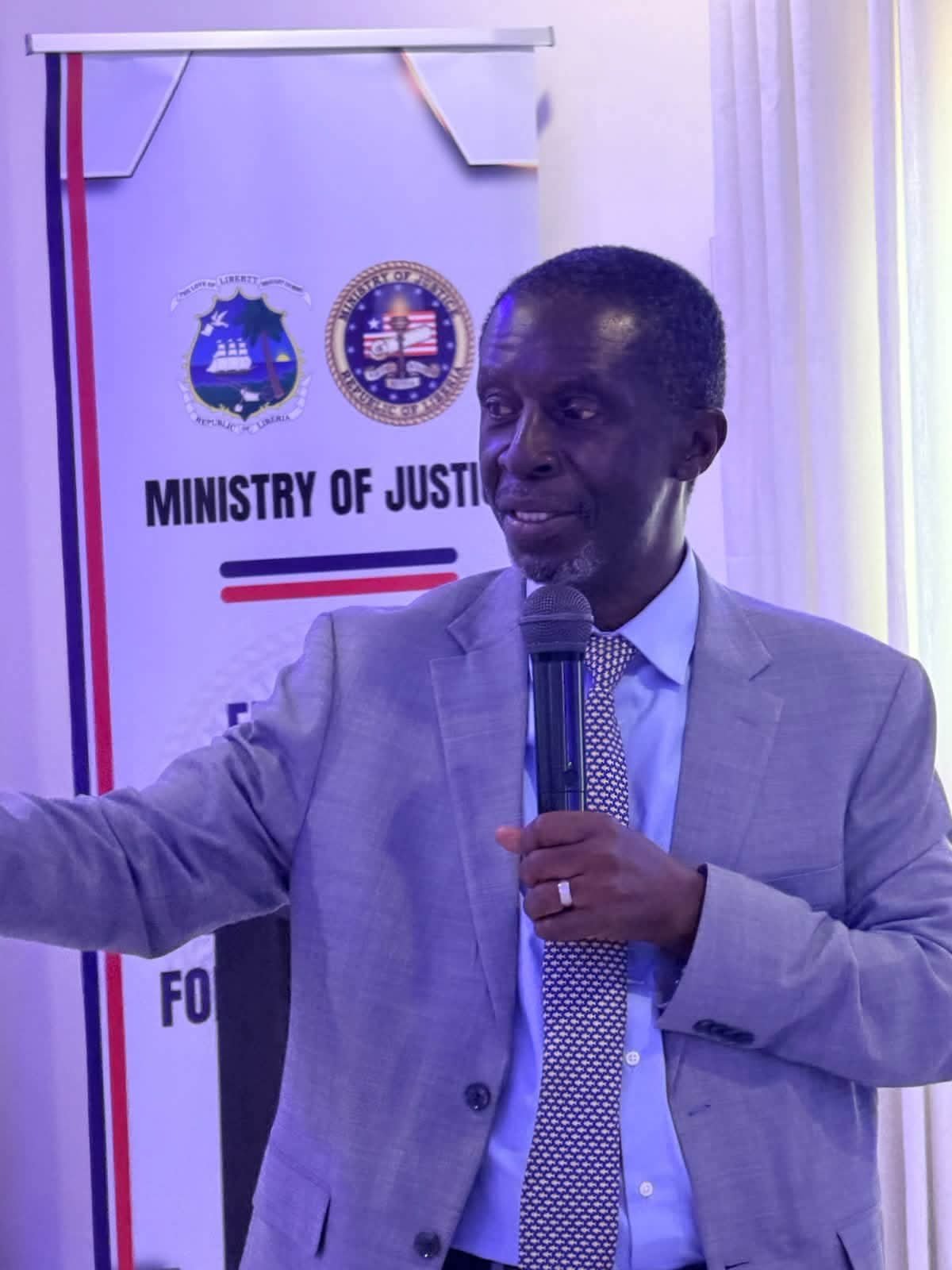
Liberian legal expert Cllr. Tiawan Saye Gongloe has urged prosecutors and investigators to pay greater attention to how evidence is collected, handled and preserved, warning that mistakes in these areas can weaken criminal cases and lead to injustice.
Gongloe made the call on October 20, 2026, while presenting a paper titled “Strengthening Criminal Prosecution through Effective Evidence Collection and Management” at a prosecution training workshop organized by the Ministry of Justice at the D’ Calabash Hotel in Congo Town.
He told prosecutors that collecting large volumes of documents and exhibits does not necessarily make a case strong, stressing that evidence must be legally obtained, properly documented and reliable enough to stand up in court.
“A thick investigation file does not necessarily contain a strong criminal case,” Gongloe said. He pointed to improperly obtained confessions, unexplained telephone records, unsupported audit findings and poorly handled exhibits as some of the problems that can undermine a prosecution.
He reminded prosecutors that evidence must be relevant to the charges, obtained through lawful means and properly identified before it can be used in court. He also stressed that the prosecution must prove every element of an offence beyond a reasonable doubt.
Gongloe urged investigators to respect the constitutional rights of suspects, particularly the protections under Article 21 of the Liberian Constitution, including the right to counsel, protection against unlawful searches and seizures, and the presumption of innocence.
He said investigators should first identify the elements of an alleged crime before gathering evidence. This, he explained, would help them determine what facts need to be established, which witnesses to interview and what documents or other exhibits are needed.
Using financial investigations as an example, Gongloe cautioned that irregular payments and procurement violations alone do not prove that a crime has been committed. Prosecutors, he said, must establish evidence linking the accused to the specific offence.
On the handling of exhibits, he called for proper records showing when and where evidence was collected, who collected it and everyone who handled it before it reached the courtroom. He also recommended unique identification numbers for exhibits, secure storage and regular checks.
Gongloe warned prosecutors against altering records, backdating entries or hiding gaps in the handling of evidence, saying such practices could damage the credibility of a case. Where a break occurs in the chain of custody, he said, it should be properly investigated and honestly documented.
He also addressed the use of scientific and digital evidence, including DNA samples, fingerprints, telephone records and electronic messages. He cautioned that a screenshot or a name displayed on a telephone does not, by itself, prove who sent a message. Prosecutors must establish the source, authenticity and manner in which such evidence was obtained.
The legal expert further reminded prosecutors to preserve evidence that may contradict their case, including negative laboratory results, inconsistent witness statements and information that could support an accused person’s innocence. He said witnesses should be helped to understand court procedures but must never be coached to give particular answers.
To improve the work of prosecutors and investigators, Gongloe recommended a common evidence-management system, closer cooperation between the police and prosecution, trained evidence custodians and secure facilities for storing exhibits. He also called for adequate funding for forensic examinations, transportation, packaging and preservation of evidence.
Reflecting on his time as Solicitor General, Gongloe recalled that when he took office in 2006, Liberia had very few trained lawyers serving as county attorneys. He said efforts were made to appoint law school graduates across the 15 counties and secure scholarships through the Open Society Initiative for West Africa to train more prosecutors.
He welcomed the progress made since then, noting that more than 50 law school graduates are now serving as prosecutors. He encouraged the current generation of legal practitioners to build on the work of those who served before them.
Gongloe reminded prosecutors that their responsibility is not simply to secure convictions but to ensure that cases are handled fairly and according to the law.
“The strength of a prosecution of any case lies in proof that withstands fair scrutiny,” he said.