


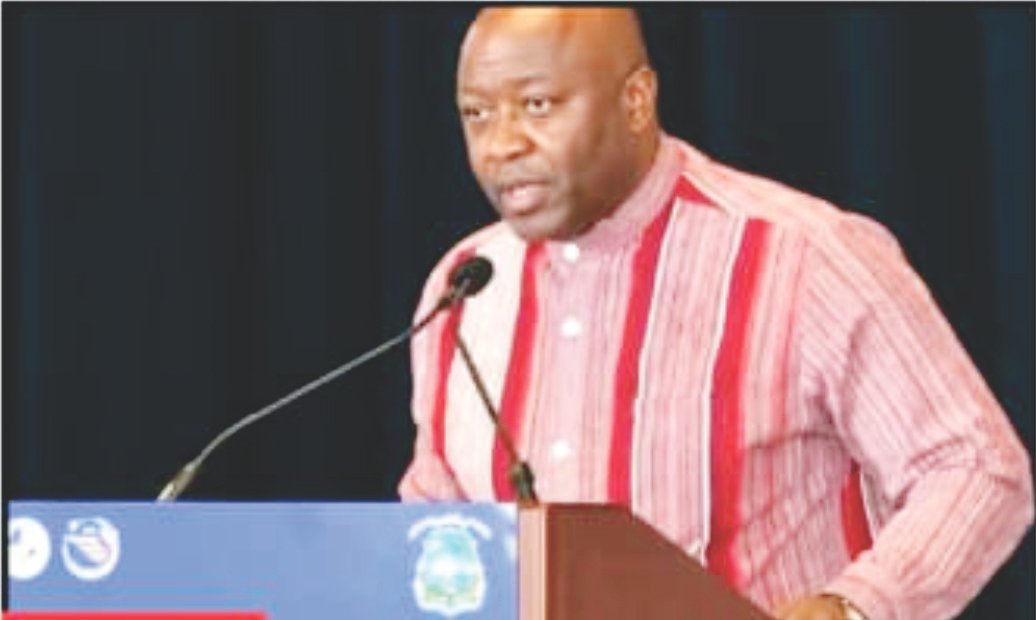
Liberia’s Minister of Finance and Development Planning, Augustine Kpehe Ngafuan, has called on Liberians in the diaspora and international investors to place greater confidence in the country’s emerging economic opportunities, pointing to ongoing improvements in infrastructure, electricity, financial technology and industrial development.
Ngafuan made the statement on September 26, 2026, while addressing the Liberian Diaspora Conference in Washington, D.C., under the theme “Making an Investment Case for Liberia—Betting on Liberia.”
“Bet on Liberia because roads, power, payment systems and industrial platforms are beginning to connect opportunity with people,” Ngafuan said.
The Finance Minister said Liberia’s investment prospects must be viewed against the country’s progress since the end of the civil war, including more than two decades of peace, democratic elections and peaceful transfers of political power.
He argued that Liberia is increasingly moving from post-conflict recovery toward an economy seeking to attract investment, expand production and strengthen domestic capacity.
Ngafuan cited recent economic indicators as evidence of the country’s changing economic environment.
Liberia’s economy grew by about 5.1 percent in 2025, while the International Monetary Fund projected growth of approximately 5.5 percent in 2026, with mining, construction and manufacturing identified among the major drivers.
He also highlighted improvements in domestic revenue mobilization, noting that Liberia recently crossed the US$1 billion mark in domestic revenue collections for the first time.
Ngafuan cautioned, however, that the revenue milestone should not be interpreted as meaning that the government has sufficient resources to resolve all of Liberia’s development challenges.
He said increased revenue must finance a wide range of national obligations, including salaries, education, healthcare, security, infrastructure, county development and debt servicing.
According to the Minister, the significance of the milestone is that it demonstrates growing capacity for Liberia to finance its own development.
Infrastructure formed a major part of Ngafuan’s investment argument.
He pointed to ongoing road construction and rehabilitation, including major corridors intended to improve domestic connectivity and regional trade. He also referenced the construction of a new bridge across the Cavalla River to strengthen Liberia’s connection with Côte d’Ivoire.
The government is also expanding electricity access, procuring road-maintenance equipment and investing in schools, hospitals and other public facilities.
Ngafuan said these developments are intended to create the basic infrastructure required for private businesses to operate and expand.
He also highlighted the government’s efforts to modernize Liberia’s financial system.
The Central Bank of Liberia’s Inclusive Instant Payment System, launched in December 2025, initially connected major mobile-money platforms and forms part of the development of a broader National Electronic Payment Switch.
Ngafuan said the expansion of interoperable digital payments could make it easier for businesses, government agencies and individuals to transfer money, while improving transparency and reducing reliance on cash transactions.
Beyond infrastructure and financial technology, the Minister identified agriculture, agro-processing, energy, mining services, manufacturing, logistics, tourism, fisheries and digital infrastructure as areas with investment potential.
He said Liberia’s approximately 580-kilometer Atlantic coastline, natural resources and agricultural potential could provide opportunities for investors if greater value is added domestically.
The Minister particularly emphasized the need for Liberia to move beyond exporting raw materials and importing finished products.
He said investments should increasingly support local processing, job creation, technology transfer and the development of domestic supply chains.
Ngafuan also appealed to Liberians living abroad to participate more directly in productive investment rather than limiting their economic contribution to household remittances.
He identified diaspora expertise, international networks and access to capital as resources that could help connect Liberia to international markets and investment opportunities.
At the same time, Ngafuan acknowledged that Liberia continues to face significant challenges.
He cited the high cost of electricity, infrastructure deficits, limited access to finance and bureaucratic delays as issues that investors continue to consider.
“We do not present Liberia as a country without problems,” Ngafuan said. “We present Liberia as a country increasingly capable of solving problems.”
He urged prospective investors to conduct proper due diligence, examine financial information carefully and structure investments professionally rather than relying solely on patriotic considerations.
The Finance Minister said the government’s objective is to create an investment environment in which private capital can support national development while generating legitimate returns for investors.
Ngafuan said Liberia’s investment case ultimately rests on connecting the country’s natural resources and human capital with infrastructure, technology and private investment.
“Bet on Liberia because roads, power, payment systems and industrial platforms are beginning to connect opportunity with people,” he said.