
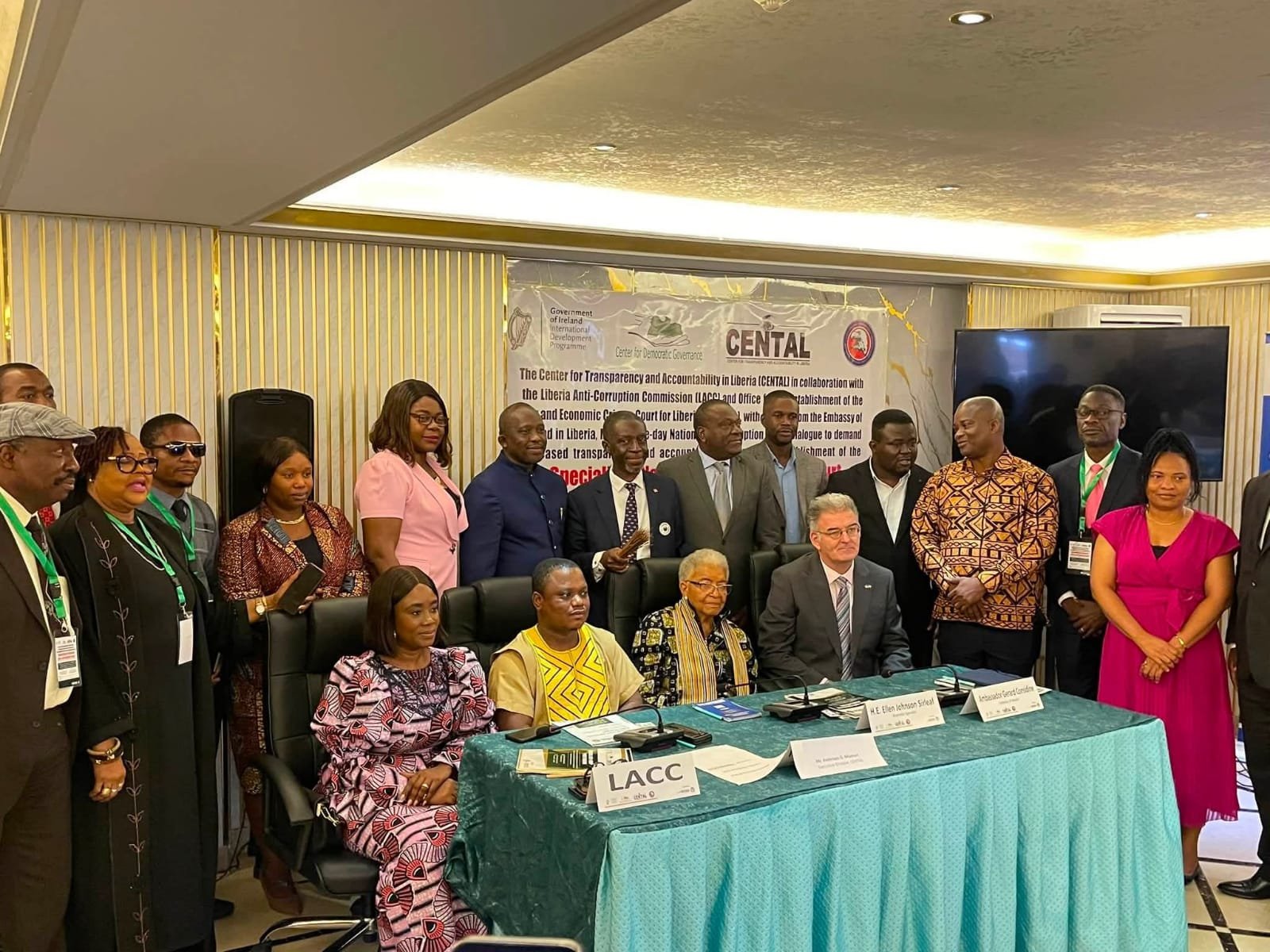
On Tuesday, June 30, 2026, Government officials, civil society leaders, legal practitioners, development partners, and anti-corruption advocates gathered at the Boulevard Palace Hotel in Sinkor for a national dialogue focused on establishing a Specialized National Anti-Corruption Court in Liberia.
The meeting brought together a broad cross-section of stakeholders to deliberate on reforms aimed at improving the handling of corruption and financial crime cases in Liberia. Participants emphasized the need for a more efficient justice process that can reduce delays and strengthen accountability mechanisms.
Held under the theme “Strengthening Transparency and Accountability in Liberia through the Establishment of the Specialized National Anti-Corruption Court,” the dialogue centered on proposals to fast-track corruption cases and improves coordination within the justice system.
Organizers, including the Center for Democratic Governance (CDG), the Center for Transparency and Accountability in Liberia (CENTAL), and Partners for Democratic Change, noted that the initiative is supported by the Government of Ireland as part of broader governance reforms.
Former President Ellen Johnson Sirleaf delivered the keynote address, calling for stronger institutions and sustained political commitment in the fight against corruption. She stressed that accountability systems must be backed by an independent and efficient judiciary to deliver meaningful results.
A panel discussion followed, featuring representatives from the Legislature, the Press Union of Liberia, the National Civil Society Council of Liberia, the Association of Female Lawyers of Liberia (AFELL), and the Office for the Establishment of the War and Economic Crimes Court for Liberia.
Speakers raised concerns about persistent delays in corruption prosecutions, gaps in coordination among justice sector institutions, and weaknesses that continue to undermine public trust in the system.
Many participants argued that a specialized anti-corruption court could help streamline cases, improve conviction rates, and restore confidence in the rule of law.
The dialogue is part of ongoing national consultations aimed at advancing governance reforms and strengthening Liberia’s capacity to investigate, prosecute, and adjudicate corruption-related offenses more effectively.