

By G. Watson Richards
Senior United Nations officials have issued a stark warning that corruption continues to erode human rights, weaken institutions, and widen inequality in Liberia and across Africa, calling for urgent and coordinated action to address the challenge.
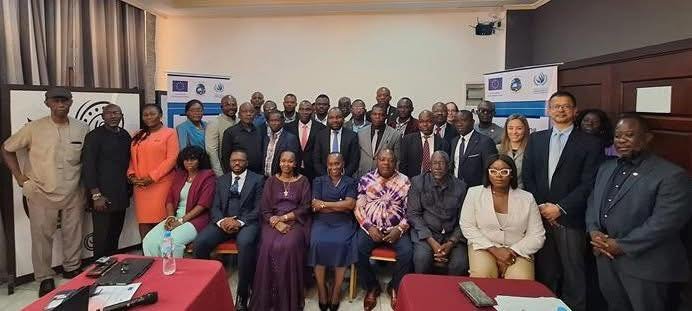
The remarks were delivered at the opening of a two-day training in Monrovia focused on investigating and prosecuting corruption through a human rights-based approach. The program is organized by the Office of the High Commissioner for Human Rights with support from the European Union.
The workshop convenes prosecutors, investigators, and other justice sector actors as part of broader efforts to strengthen Liberia’s anti-corruption framework and align enforcement with international human rights standards.
Speaking at the opening, Pradeep Wagle, Chief of Economic, Social and Cultural Rights at OHCHR, described corruption as a systemic global problem that diverts resources away from essential public services and undermines state legitimacy.
He noted that an estimated 10 to 25 percent of public funds are lost to corruption globally—amounting to roughly $3 trillion annually. This figure, he said, comes close to the approximately $4 trillion required each year to achieve global development targets.
Turning to Africa, Wagle said the continent loses more than $140 billion annually to corruption, a figure that significantly undermines its ability to meet development needs estimated at about $170 billion per year.
“These figures represent more than statistics—they reflect resources taken away from citizens,” he said, stressing that corruption directly affects access to healthcare, education, and justice.
Citing findings from the United Nations Conference on Trade and Development, Wagle added that countries affected by corruption often spend significantly less on essential services, with serious consequences for human rights and social development.
He emphasized that corruption should be viewed not only as an economic or governance issue but also as a violation of fundamental rights. According to him, it weakens institutions, erodes trust in governance, and contributes to impunity.
Particularly affected, he said, are vulnerable populations, including children, youth, persons with disabilities, and marginalized communities—who bear a disproportionate burden when public resources are misused.
Despite these challenges, Wagle acknowledged steps taken by Liberia to strengthen accountability mechanisms, including efforts to establish a war and economic crimes court and a specialized anti-corruption court, as well as reforms within the Liberian Anti-Corruption Commission.
However, he cautioned that enforcement gaps remain significant. Liberia continues to face challenges in evidence gathering, data management, and institutional capacity, which limit the effectiveness of anti-corruption efforts.
Recent indicators reflect these concerns.
According to Transparency International, Liberia scored 28 out of 100 on its Corruption Perceptions Index, ranking near the lower end globally. Meanwhile, survey findings from Afrobarometer suggest that public perception of corruption remains widespread.
Wagle also pointed to audit findings highlighting substantial financial irregularities in public institutions, warning that such losses directly affect service delivery, particularly in critical sectors like healthcare.
“There is clear evidence globally that corruption within health systems, whether through informal payments or diversion of resources-undermines the right to health,” he noted.
Also addressing the gathering, UN Resident Coordinator Christine Umutoni linked corruption to governance failures and Liberia’s past conflict, recalling findings from the Truth and Reconciliation Commission of Liberia that identified corruption as a contributing factor to the country’s civil war.
She commended Liberia for maintaining two decades of peace but stressed that sustaining it will require stronger institutions and continued reforms.
“Corruption poses a serious threat to democracy, rule of law, and fundamental freedoms,” she said, urging sustained commitment to transparency and accountability.
Representing the European Union, Chargé d’Affaires Zoltan Szalai reaffirmed the EU’s support for governance reforms in Liberia. He described corruption as a threat not only to public finances but also to fairness and justice in society.
“When public resources are misused, it is ordinary citizens, especially the most vulnerable, who suffer the consequences,” he said, emphasizing the need for due process and protection for whistleblowers.
For the Liberian government, Deputy Justice Minister for Administration Cora Hare Konuwa acknowledged the persistence of corruption despite years of reform efforts. She noted that limited resources continue to constrain prosecution efforts, even where cases are identified.
She also underscored the need for greater personal and institutional accountability, suggesting that corruption remains deeply embedded in society.
Meanwhile, OHCHR Human Rights Officer Marion Deniaud said the training forms part of broader support to Liberia’s transitional justice agenda, including plans to establish specialized courts to address both corruption and past war-related crimes.
The two-day program combines technical sessions, case studies, and practical exercises aimed at improving investigative techniques, strengthening coordination among institutions, and embedding human rights principles into anti-corruption work.
Participants are expected to leave the training better equipped to translate international standards into effective national action, an essential step, organizers say, in restoring public trust and advancing Liberia’s development goals.