
By Fanta Kamara
There is a story Liberia tells itself every year.
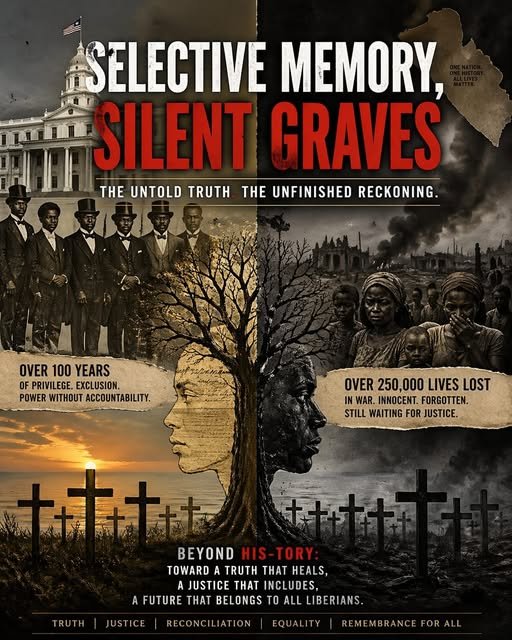
It is a story of 13 men; 13 powerful men killed in April 1980. Their deaths are remembered, marked, and carried forward by those who refuse to let the nation forget. Their names live in speeches, in ceremonies, and in the collective memory of a particular class.
But there is another story. A larger one. A heavier one. And it is told mostly in silence.
For over a century, the descendants of freed slaves later known as Americo-Liberians, ruled Liberia, consolidating political, economic, and social power while excluding the vast majority of indigenous people from meaningful participation in their own country. Citizenship, land ownership, and opportunity were restricted, creating a system that mirrored the very hierarchies many of those settlers had once fled. Only 4% of the population they owned nearly 70% of all of Liberia’s prime lands and continues to orchestrate and influence political and economic activities, often acting and brokers and bureaucrats.
Far from revisionism, it is the record, explicit.
The events of April 1980 did not emerge from a vacuum. They were born from generations of inequality, resentment, and systemic exclusion, where the indigenous were not only oppressed but enslaved and trafficked, denied citizenship in their birthland until 1904. The coup that overthrew that ruling class, and the execution of 13 officials became a defining moment in Liberian history. For some, it remains a symbol of unjust brutality. For others, it marked the violent collapse of a long-standing injustice.
History did not stop there. What followed in the years ahead was far from justice; instead, it was uttered devastation.
Civil wars tore through Liberia, leaving an estimated 250,000 people dead. Entire communities were erased, wiped out. Families were shattered. Children became soldiers. Violence became language. And yet, for all the scale of this suffering, there are no equal rituals of remembrance. No widely observed national mourning that centers the countless unnamed lives lost.
Why?
Why does one tragedy receive annual recognition, while another, vastly larger in scale, fades into fragmented memory?
Let’s be clear, this is not about diminishing one loss to elevate another. Grief is not a competition. But selective remembrance is not neutral, it reflects power, influence, and whose narratives are preserved.
A nation cannot heal through partial memory.
Liberia’s future depends on its willingness to confront ALL of its past, not just the parts that are politically convenient or socially reinforced. The pain of the 13 men executed in 1980 is real. But so is the pain of the hundreds of thousands who died in the chaos that followed. One does not cancel out the other.
True reconciliation requires more than commissions, reports, or symbolic gestures. It demands accountability. It demands inclusion. And it demands that every Liberian life be given equal VALUE in the story of the nation.
Where are the memorials and exhibitions for the unnamed?
Where are the national days of mourning for entire communities lost?
Where is the justice for victims whose suffering has never been formally acknowledged?
Until these questions are answered, not selectively, but collectively, Liberia remains a nation remembering only part of itself.
And a country that remembers selectively cannot truly heal.
It can only repeat.
FOR LOVE OF COUNTRY
~FK,MBA~