

By G. Watson Richards
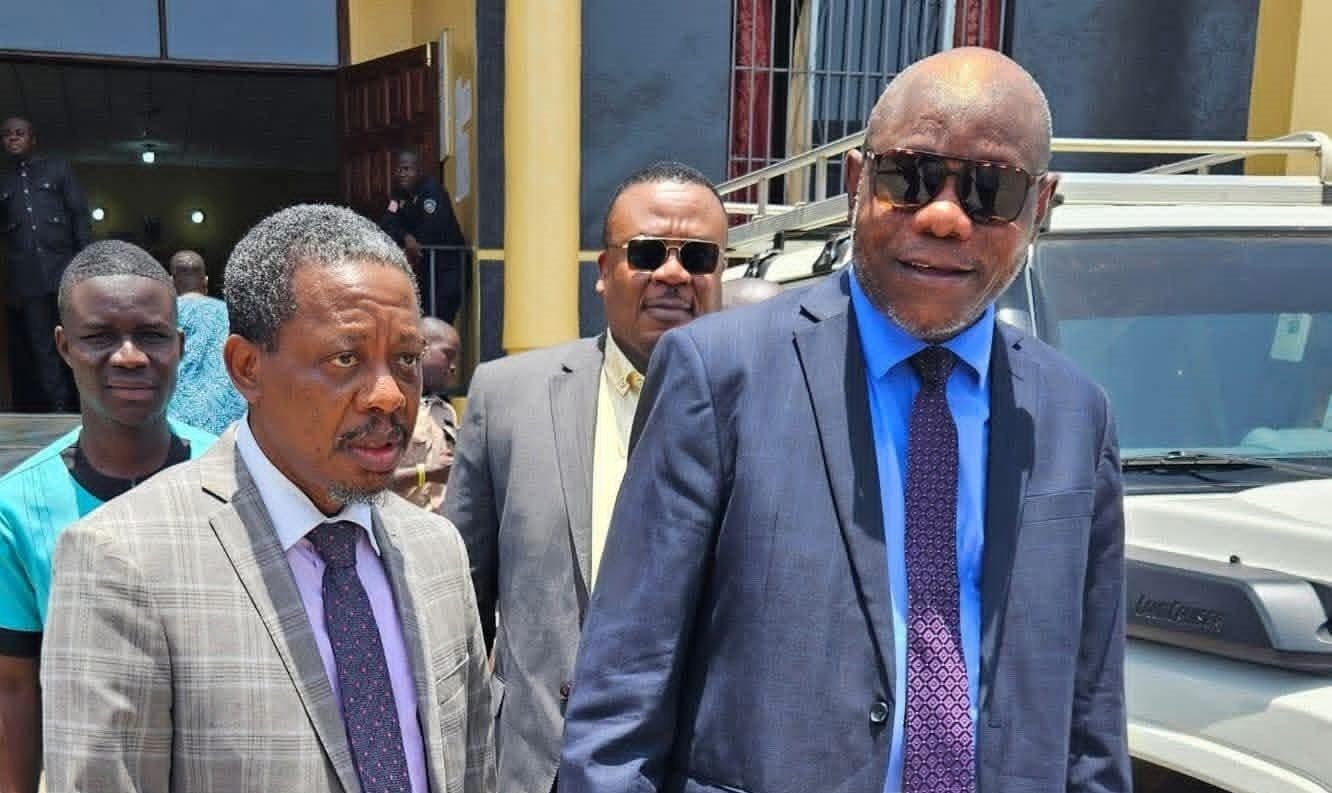
Former Finance and Development Planning Minister Samuel D. Tweah, Jr. took the witness stand in Criminal Court ‘C’ on Monday, April 20, 2026, laying out his defense in a detailed but at times inconsistent testimony that quickly drew the attention of State prosecutors.
Tweah, who served from January 2018 to January 2024, is standing trial with four other former officials over allegations that they approved more than L$1 billion and US$500,000 in public funds through the Financial Intelligence Agency (FIA) outside proper procedures.
Instead of settling questions about his role in the disbursements of US$6.2 million funds channeled through the Financial Intelligence Agency (FIA) allegedly intended for National Security Council (NSC), his testimony raised new ones, especially about how the decisions were made and whether they followed the law.
While testifying on the stand, Tweah relied heavily on two instruments: the Public Financial Management (PFM) Law and the National Budget. But as he explained his position to the court and jury, his interpretation appeared to shift, with prosecutors suggesting he was bending the rules to fit the actions in question.
At one point, Tweah said government spending does not require formal requests from agencies, arguing that once the national budget is passed, the Finance Minister has full authority to spend. Earlier, however, he had described requests as the main trigger for releasing funds.
That contradiction did not go unnoticed. Prosecutors pointed to it as a sign that his explanation was changing under pressure.
On emergency spending, Tweah told the court that approval from the National Security Council (NSC) gives the Finance Minister complete authority to act. But under the PFM Law, specifically section 15, it states that any spending outside the approved budget must still be reported to the Legislature.
Tweah did not say whether such reporting was done in the case of the FIA transfers, something prosecutors say is a serious omission.
He also defended the use of a “direct debit” method to move funds, saying it was part of the normal budget process. But he admitted the funds were not pre-allocated and could be assigned later, raising doubts about whether the process followed standard financial rules.
When asked about missing documents, including written requests to support the transfers, Tweah brushed off the concern.
He testified that the absence of paperwork does not automatically mean wrongdoing.
According to prosecution, documentation is a basic requirement in public finance, and its absence can itself point to a violation of the PFM Law.
Tweah further stated that the Finance Minister has sole discretion over when and how funds are released. That claim also drew pushback, with prosecution noting that such authority is limited by law and must follow established procedures and reporting rules.
In defending himself against allegations of money laundering, Tweah sought to simplify the concept for the jury, comparing it to “washing” money to make it appear clean. He rejected the accusation outright, insisting his actions as Finance Minister were lawful.
“I oversaw about US$3.5 billion under my signature as Minister of Finance. The prosecution wants you to believe that all I did over six years was launder money. The transactions in question were legal and legitimate. So, honorable members of the jury, remove from your minds any suggestion of money laundering,” Tweah to the court and jury while on the witness stand.
Responding to allegations of conspiracy involving the Financial Intelligence Agency (FIA) and the National Security Council, Tweah dismissed the claim as baseless.
“Everything about that charge rests on a faulty assumption. If the foundation is wrong, then the conclusion cannot stand,” he said.
He maintained that the FIA was already part of the joint security framework and did not require special approval to participate.
“The FIA was already a member of the joint security. If the argument is that there was no request for its inclusion, then that argument itself is based on confusion,” he asserted.
Tweah also pointed to his working relationship with the FIA during his time in office, noting that he worked closely with the agency and international partners in efforts to combat money laundering and terrorist financing.
Over nearly two hours, Tweah moved between legal arguments and personal explanations, but some of his statements appeared to create more doubt than clarity.
With the trial ongoing, the jury now has to decide whether his actions were within the law, or whether the inconsistencies in his testimony point to something else.