


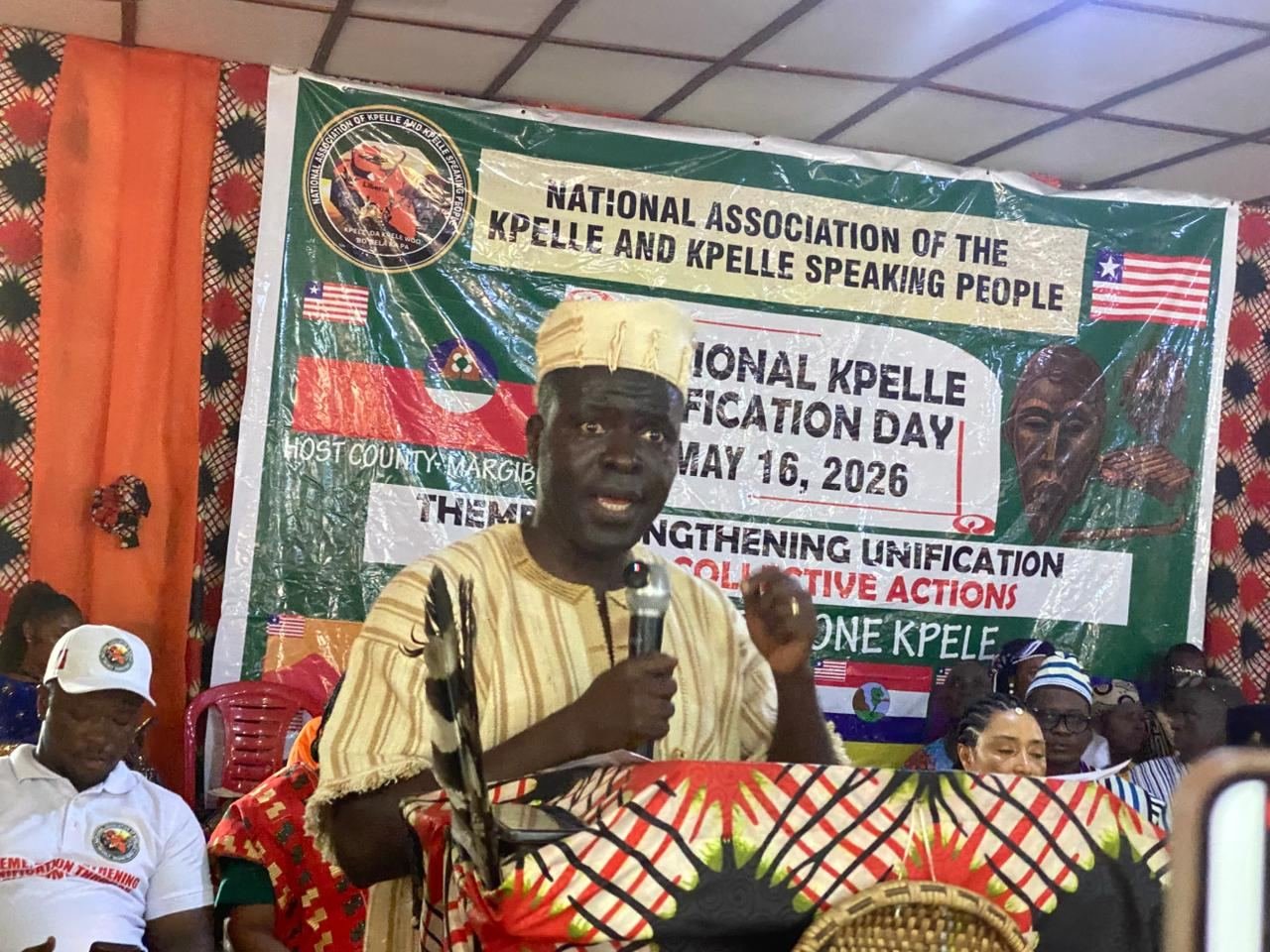
By Dr. Emmanuel K. Urey Yarkpawolo
Executive Director
Environmental Protection Agency of Liberia
Kakata, Margibi County
May 16, 2026
Theme: “Kpelle Unity for Cultural Renewal, Peace, Development, and National Progress”
Protocol
Traditional leaders, chiefs, elders, zoes, and community leaders;
Officials and members of the National Association of Kpelle and Kpelle-speaking People;
Honorable officials of government;
Religious leaders;
Women leaders;
Youth representatives;
Distinguished guests;
Fellow Liberians;
My dear Kpelle brothers and sisters, fathers and mothers:
I bring you greetings with humility, respect, and responsibility. I thank the organizers for inviting me to serve as keynote speaker for this National Kpelle Unification Day. To speak on unity is to speak about history and destiny; about who we are and who we must become.
Today, we gather not merely to celebrate a tribe, but to reflect on a people, a culture, a language, a responsibility, and a future. We gather as Kpelle people and as Liberians. Kpelle unity must never be unity against any group. It must be unity for cultural dignity, peace, development, education, women and youth empowerment, and the progress of Liberia. My central message is simple: a united Kpelle people must become a stronger force for a united Liberia.
The Meaning and Responsibility of Unification
First, unification means bringing together what has been separated, healing what has been wounded, and building bridges where walls have been built. It is not only the absence of conflict; it is the presence of shared purpose. We have seen how division weakens families, communities, institutions, politics, and collective voice. True unification requires cooperation over division, respect over jealousy, service over selfishness, and the future over the past.
This responsibility is greater because the Kpelle people are central to Liberia’s national identity. We are the largest ethnic group in Liberia, representing over 20 percent of the population. This is not merely a statistic; it is a summons to leadership. To be the largest is a burden of responsibility. The largest must also be peaceful, organized, generous, disciplined, and committed to the common good. If the Kpelle people are divided, Liberia feels it. If we are united, Liberia benefits. Therefore, Kpelle Unification Day is a national development and peacebuilding event.
One People Beyond County Boundaries
Second, our unity must rise above county boundaries. The Kpelle people are found across central and western Liberia and beyond Liberia’s borders into Guinea. Our dialect belongs to the Mande branch of the Niger-Congo language family, reminding us that Kpelle identity is deeper than county lines. We may speak of Bong Kpelle, Margibi Kpelle, Gbarpolu Kpelle, Lofa Kpelle, Bomi Kpelle, or Guinea Kpelle, but these are descriptions of place, not divisions of destiny. The town may differ, the accent may vary, and the county may change, but the ancestry, memory, and spirit remain one.
Therefore, when we speak of “Kpelle unity,” we are not inventing a new idea. We are recovering an old inheritance: authority that served the people, diplomacy that prevented conflict, community defense that protected life and land, social order that kept families and towns together, and service that placed community welfare above personal ambition. Long before modern politics and formal offices, Kpelle communities organized life, settled disputes, protected farms, respected elders, guided youth, and preserved culture. To unify today is to bring that inheritance into modern Liberia: accountable leadership, respect for elders and women, education for youth, protection of land and rivers, peaceful dispute resolution, and service to the Republic.
Culture, Governance, and Wisdom
From this inheritance comes a culture of work and responsibility. Historically, our people have been hardworking. Rice remains our major staple food. Our ancestors knew that the soil was not merely dirt; it was life. Today, Kpelle agriculture must move beyond subsistence into agribusiness, processing, climate-smart agriculture, finance, and markets. The Kpelle people have fed Liberia with their hands; now we must help feed Liberia with our minds, institutions, businesses, technology, and leadership.
Culture is also a system of values. It teaches us how to greet elders, raise children, resolve conflict, respect land, work together, correct wrongdoing, and live with dignity. Before modern courts and offices, our people practiced mediation, reconciliation, accountability, and restorative justice. We do not need to return blindly to the past, but we must recover values that helped our communities survive: respect, discipline, patience, truth-telling, hard work, humility, and reconciliation.
Kpelle tradition teaches us that indigenous governance was not in disorder. It had authority, legitimacy, diplomacy, and territorial responsibility. Chiefs and elders organized community life, settled disputes, protected villages, preserved customs, and guided relations with neighbors. Their legitimacy came from service, wisdom, courage, and public trust. Modern Kpelle unity must be organized around responsible leadership that listens, reconciles, protects the vulnerable, respects women and youth, defends the land, and places community welfare above personal gains.
Kpelle wisdom says, “The way the river flows at the surface is not the way it flows underneath.” A community may appear calm while grievances flow beneath the surface. True leaders listen deeply, reconcile honestly, and heal what cannot always be seen. Chief Suah Koko’s diplomacy reminds us that governance is not only about titles; it is about peace, organization, promises, resources, and community survival.
Language, Oral Tradition, and National Unity
Therefore, our next duty is cultural preservation, beginning with our language. When a people lose their language, they lose a library of memory. Language carries wisdom, prayer, history, place names, family names, and the soul of a people. Today, too many children identify as Kpelle but cannot speak Kpelle, while too many parents speak English at home but neglect the language of the grandparents. This is not progress; it is cultural erosion.
At the same time, the future gives us opportunity. English-Kpelle machine translation work shows that Kpelle can be part of the digital future if we invest in our language and technology. Parents must speak Kpelle to their children; schools must respect Kpelle learning; radio stations must create Kpelle programs; churches, mosques, and community groups must use Kpelle; and young people must never be ashamed of their language.
Our language is strengthened by music, storytelling, and oral tradition. Our songs are not only entertainment; they are archives. They carry history, warning, wisdom, protest, prayer, and identity. As Marcus Garvey reminded us, “A people without the knowledge of their past history, origin, and culture is like a tree without roots.” For the Kpelle people, unity must be rooted in memory. A tree without roots may stand briefly, but it cannot survive the storm.
Yet, as we preserve identity, we must place it within Liberia’s national framework. Liberia’s National Unification Day promotes justice, equality, fair play, and equal opportunity for all citizens. We gather as Kpelle people not to separate ourselves from Liberia, but to serve Liberia better. Tribal identity becomes dangerous when it teaches superiority, but powerful when it teaches responsibility. Kpelle unity must mean cultural confidence, moral responsibility, and national service.
Division, Peace, and Women’s Leadership
Because unity must be honest, we must name what weakens us. Sometimes we are divided by politics, county, clan, family disputes, jealousy, religion, education, money, class, and the distance between Monrovia and the village. But no people can rise when internal division becomes stronger than collective purpose. Kpelle woo Sani ta aa nei kua. Nyeei, A ke yaba ke pere mu, ife gbei kolon a boi nai. A Kpelle parable teaches us “If you are not inside a house, you do not know where it leaks.” Today, we are inside the Kpelle house. We know the leaks: division, jealousy, political bitterness, poverty, disrespect for elders, neglect of youth, and weakening language. Because this is our house, we must repair it together.
Chief Lango Lippaye example remains instructive. Her history teaches that strength is not endless conflict. True strength is the courage to defend one’s people and the wisdom to choose peace when peace will save lives. Our communities need leadership that stands firm when people are threatened, but also negotiates, reconciles, and prevents suffering.
No serious discussion of Kpelle unity can ignore women. Women are the first teachers of language. They hold families together, farm, trade, pray, organize, discipline, and preserve the moral life of the home. If we unify the men and leave women behind, we have only organized half of the house. Chief Suah Koko gives us historical authority to say this. She was not symbolic; she exercised real authority in a difficult period of Liberian history. Kpelle unification must include women’s leadership, girls’ education, protection from violence, access to land and finance, and respect for women’s dignity.
Youth, Future Leadership, and Development
Equally important, we must speak to the youth. You are not the future only; you are the present. The choices you make today are shaping the Kpelle people and Liberia. Identity without discipline is empty. Pride without education is dangerous. Energy without direction can destroy. Yei mo non a ger e ka Kpellenu. Et kpo makerke, e ka a nu lele? e ka a nu a tania mo? e ka nu a tege? If Chief Dolokelen Gboveh, Chief Doloken Paye, Kolleh Gwee, Gboto Barclay, Chief Suah Gborkorquellie, and in our recent memory, Chief Jimmy Kollie were here, am sure they would warn us by saying. “Do not only say, I am Kpelle.” Ask yourself: Am I honest, hardworking, respectful, learning, serving, building, and avoiding drugs, violence, crime, and destructive behavior? These are the marks of Kpelle character: humility is strength, honesty is honor, and hard work is dignity.
Kunuu-polo-nai di wolo mo diyeei, molon pai kpetei a neleei, kwa gaa zime ba. Our elders say, “The rice that will grow well can be known from its sprouting.” The future of Kpelle leadership is already sprouting today in our children, students, young professionals, farmers, young women, and young men. If we want strong presidents, wise chiefs, honest ministers, prepared teachers, entrepreneurs, transparent lawmakers, and community leaders tomorrow, we must cultivate discipline, education, humility, and service today.
For that reason, Kpelle leaders, professionals, elders, businesspeople, and citizens at home and abroad should establish a Kpelle Education and Scholarship Initiative to support rural students, girls, vocational training, teachers, agriculture, medicine, environmental science, public administration, and entrepreneurship. No unification is complete if children remain uneducated and parents remain economically poor.
However, education must lead to development. Celebration alone is not development.
Kunuu-polo-nai di wolo mo nono kua diyee, wului kelee a pumai, gelee nofei a mba a tan kelee. Our elders remind us: “Trees which bear flowers do not always bear fruit.” Today, our celebration is beautiful. The speeches, dances, and cultural displays are flowers. But after today, the Kpelle people must produce fruit: leadership, scholarships, women’s empowerment, youth mentorship, land protection, and unity across counties. Let this gathering consider a Kpelle Development Agenda focused on empowerment, education, agriculture, culture, health, roads, environment, and entrepreneurship. Unity must be organized, financed, measured, and made productive.
Protecting the Land and Embracing a Kpelle Unification Compact
Finally, as someone born in Gomue Village, Kpaquellie Clan, Zota District, Bong County, who started school at age 14 and now works in environmental governance, I must speak about the land. The Kpelle people are blessed with fertile land, forests, rivers, and minerals. But blessings can become curses if mismanaged. Illegal mining, forest destruction, river pollution, unsustainable farming, and careless land use threaten communities and future generations. A people cannot claim love for their ancestors while destroying the land those ancestors protected for them.
Development, roads, mining, and agriculture are necessary. But all development must respect communities, protect water sources, follow the law, benefit local people, and preserve the inheritance of future generations. Let us teach our children that land is not only property. Land is memory, livelihood, identity, and a covenant between generations.
Therefore, I propose a Kpelle Unification Compact built around six commitments. First, one people: reject county-based division, clan-based hatred, and political bitterness. Second, one language: preserve, speak, teach, document, and modernize Kpelle. Third, one responsibility: commit to leadership, peace, humility, and national service. Fourth, one future: educate youth, empower women, support elders, and create opportunity. Fifth, one land: protect forests, rivers, farms, towns, sacred places, and natural resources. Sixth, one Liberia: ensure Kpelle unity strengthens Liberian unity.
Conclusion
My brothers and sisters, fathers and mothers, we cannot change the past, erase every division, or solve every problem in one day. But we can decide that Kpelle unity will mean more than cultural display; it will mean service. Kpelle identity will mean more than language; it will mean values. Kpelle leadership will mean more than population size; it will mean responsibility. Kpelle development will mean more than individual success; it will mean collective progress.
Let this Unification Day continue after the drums stop and speeches end. Let it live in how we raise our children, respect elders, treat women, guide youth, protect land, preserve language, build communities, and serve Liberia.
May the Kpelle people be united. May our unity strengthen Liberia. May our culture live. May our children rise. May our land be protected. May our elders be honored. May our women be empowered. May our youth be educated. And may Liberia become stronger because the Kpelle people have chosen unity, peace, development, service, and leadership.
I thank you.
See less