


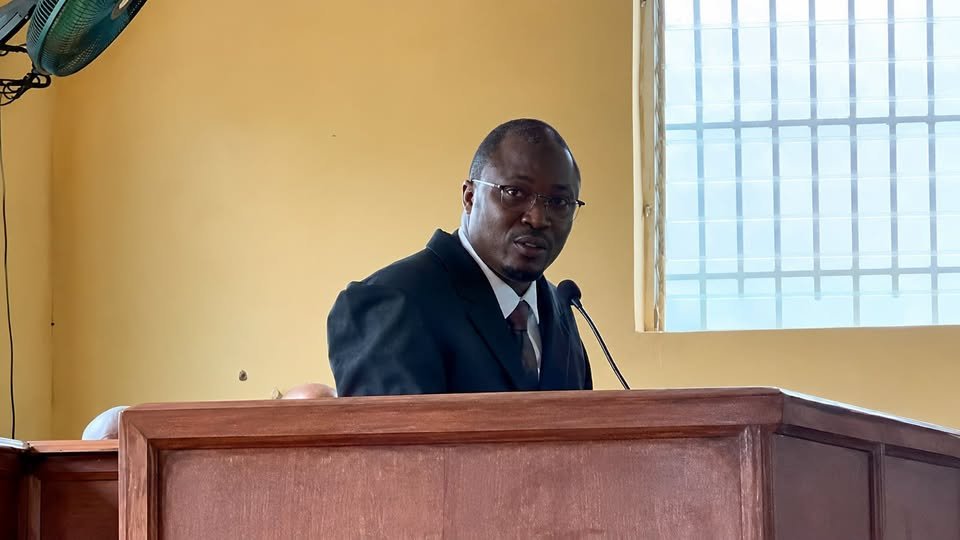
By: Hon. Atty. Richlue O. Burphy
Introduction
The presumption of innocence is a cornerstone of criminal justice in Liberia. No matter the charge, one is presumed innocent until proven guilty in a court of law. This is provided for in Article 20(b) of the 1986 Constitution of Liberia (Amended) which states that “No person shall be held to answer for a capital or infamous crime, unless on presentment or indictment by a grand jury, and every person charged with a crime shall be presumed innocent until proven guilty beyond a reasonable doubt.”
It endures until the prosecution discharges its burden of proof. The Supreme Court has consistently held that guilt must be established beyond reasonable doubt, while the defense need only raise reasonable doubt. When one looks at the language and the words being used, you would be tempted to think that they are similar but in legal sense, they are completely different. These two linguistically similar concepts embody distinct legal duties, responsibilities and consequences. And this article seeks to clarify their doctrinal contours and practical significance, thereby situating them within the broader philosophy of criminal justice.
The Prosecutor’s Burden: Proving Beyond Reasonable Doubt
The prosecution in Liberia bears the affirmative duty to prove every essential element of the offense charged. This duty is not a mere procedural formality; it is the substantive requirement that anchors the presumption of innocence guaranteed under our laws.
In Nyazee Barway et al v. Republic of Liberia, the Supreme Court articulated the principle that “judgment in a criminal case must be supported by proof of all the elements of the crime beyond reasonable doubts.” This case established that the prosecution must present evidence that is not only credible but also compelling enough to exclude reasonable hypotheses of innocence. Suspicion, conjecture, or circumstantial inference without corroboration cannot sustain a conviction.
The Court has clarified that proof beyond reasonable doubt does not equate to absolute certainty, which is unattainable in human affairs. Instead, it requires moral certainty. I will talk about absolute certainty and moral certainty some of time. But this standard requires that the trier of fact be left with no rational doubt as to the accused’s guilt.
In Kamara Burphy v. Bureau of Traffic, 25 LLR 12 (1976), the Court reaffirmed that “One of the most important legal presumptions is that of innocence. This presumption, which in legal phraseology, ‘gives the benefit of a doubt to the accused,’ is so cogent, that it cannot be repelled by any evidence short of what is sufficient to establish the fact of criminality with moral certainty. The prosecution must therefore build a case that is internally coherent, corroborated by reliable testimony, and supported by documentary or physical evidence. The Court emphasized that the prosecution’s burden is not discharged by presenting fragmented or contradictory evidence, but by constructing a narrative that withstands scrutiny and leaves no room for reasonable doubt.
The law further explains that the prosecution must prove each element of the crime; that is to say, the actus reus (the criminal act), the mens rea (the criminal intent), causation, and any attendant circumstances prescribed by statute. Failure to prove even one of these essential elements results in acquittal.
This burden also extends to procedural safeguards. Evidence obtained in violation of constitutional rights, such as unlawful searches or coerced confessions, cannot be used to meet the standard of proof. The Court has consistently held that due process is integral to the prosecution’s burden; proof beyond reasonable doubt must be achieved lawfully.
This goes to say that the prosecutor’s burden is twofold: substantive and procedural. The substantive is where the prosecutor must prove guilt with moral certainty by establishing all elements of the offense. And the procedural is where the prosecutor must ensure that the evidence relied upon is obtained and presented in compliance with constitutional and statutory safeguards.
When the prosecution fails to meet this burden, the obvious results is acquittal, regardless of circumstantial suspicion, public opinion, or the gravity of the alleged offense. This doctrine reflects the Liberian judiciary’s commitment to fairness, ensuring that liberty is not truncated unless guilt is proven to the highest standard recognized in law.
The Defense Lawyer’s Art: Raising Reasonable Doubt
On the other side of the adversarial divide stands the defense lawyer, whose role is equally vital to the integrity of criminal justice. Unlike the prosecution, the defense carries no burden to prove innocence. By law, the accused is already cloaked in the presumption of innocence as previously stated. The prosecution must prove guilt; the defense need only ensure that such proof is not beyond reasonable doubt.
The defense lawyer’s task is therefore to raise doubt. By that, they must demonstrate that the prosecution’s case is not airtight, impermeable, or free from contradiction. This is achieved primarily through the art of cross‑examination. And on the cross is where witnesses are tested for credibility, consistency, and reliability. By exposing contradictions in testimony, highlighting gaps in the chain of evidence, or presenting alternative explanations consistent with innocence, the defense undermines the prosecution’s narrative.
In this case, we can say that the defense’s burden is therefore negative rather than affirmative. It does not require proof of innocence, but rather the exposure of weaknesses in the prosecution’s case. This distinction is crucial, for it ensures that the presumption of innocence remains substantive in the court of law. What is important to note is that raising doubt is not a mechanical exercise. It is an art rooted in advocacy, strategy, and forensic skill. Every defense lawyer must be proficient at identifying improbabilities, inconsistencies, and procedural irregularities that cast shadows over the prosecution’s evidence.
Moreover, the defense may invoke constitutional safeguards to raise doubt. For example, evidence obtained through unlawful searches, coerced confessions, or violations of due process can be challenged and excluded in the court. In such instances, the defense not only raises doubt about the reliability of the prosecution’s case but also reinforces the constitutional guarantee of fair trial.
The art of raising reasonable doubt lies in precision and persuasion. A single contradiction in a witness’s testimony, a missing link in the chain of custody, or an unexplained delay in reporting can suffice to prevent conviction. The defense lawyer’s skill is measured not by the ability to prove innocence but by the ability to ensure that guilt is not proven beyond reasonable doubt.
Thus, raising reasonable doubt is both a strategic weapon and a constitutional safeguard. It preserves the balance of fairness in criminal adjudication, ensuring that liberty is not truncated unless guilt is established to the highest standard recognized in law. In this way, the defense lawyer’s art complements the prosecutor’s burden, together forming the twin pillars upon which justice rests.
The doctrine reflects the maxim that it is better for ten guilty persons to go free than for one innocent person to be wrongfully convicted. The Supreme Court has emphasized that reasonable doubt must arise from the evidence, not speculation or sympathy. It is a rational doubt grounded in reason and common sense. This philosophy prioritizes liberty and fairness over expediency, ensuring that criminal justice remains anchored in moral certainty rather than conjecture.
Trial courts evaluate whether the prosecution’s evidence meets the threshold of moral certainty. Defense counsel strategically raises doubt by challenging credibility, motive, or chain of custody. Appellate courts also scrutinize whether trial judges properly applied the standard.
Conclusion
The distinction between proving beyond reasonable doubt and raising reasonable doubt is fundamental to Liberian criminal jurisprudence. The prosecution must affirmatively establish guilt with moral certainty; the defense must merely expose weaknesses sufficient to sustain doubt. Together, they form the twin pillars of fairness, ensuring that liberty is not sacrificed to expediency and that justice remains anchored in reason.
References
Kamara Burphy v. Bureau of Traffic, 25 LLR 12 (1976),
Nyazee Barway et al v. Republic of Liberia
The Constitution of Liberia (amended), 1986
About the Author
Hon. Atty. Richlue O. Burphy is a Liberian lawyer and also serves as Deputy Director General for Lotto Games at the National Lottery Authority, where he contributes to governance, institutional reform, and regulatory oversight. Beyond his legal practice, Burphy is a seasoned public servant, policy analyst, and development worker, with specialized expertise in land tenure and property rights. His professional work reflects a strong commitment to advancing the rule of law, strengthening institutions, and promoting sustainable development. He has authored scholarly works on criminal justice, governance, and management, and is recognized for his structured, analytical writing style that bridges legal advocacy with policy discourse.