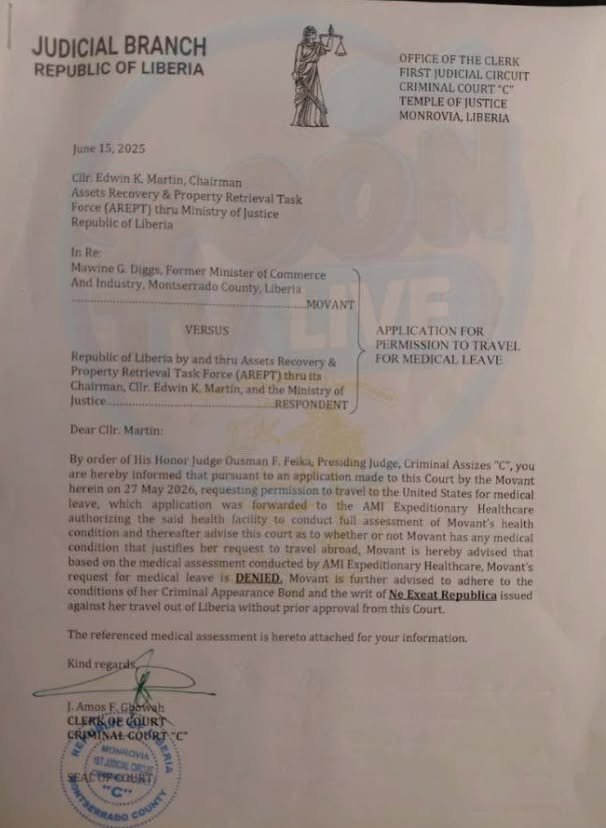


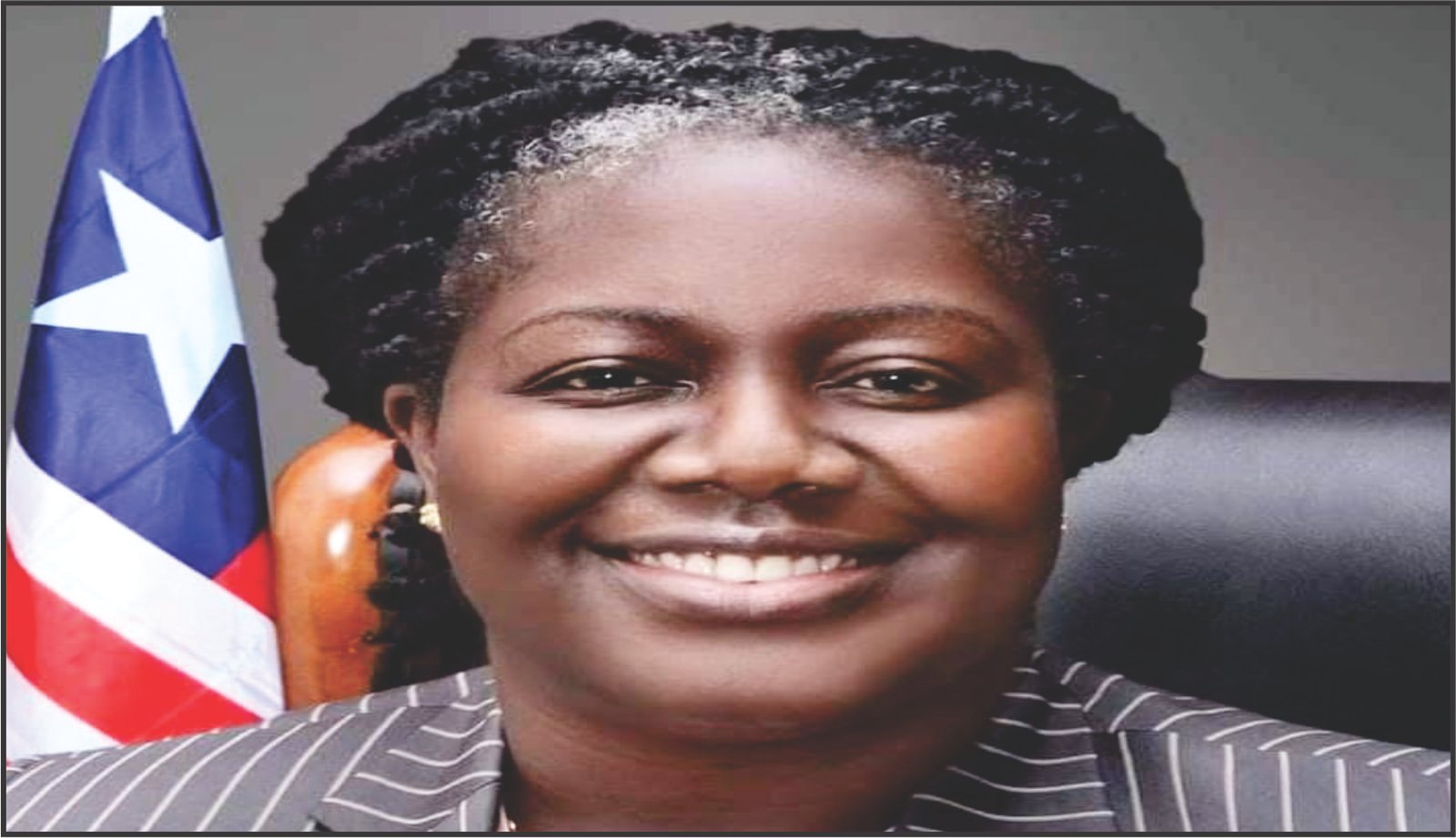
The presiding judge of Criminal Court ‘C’ at the Temple of Justice Osuman F. Feika has denied a request by former Commerce Minister Mawine G. Diggs to travel outside Liberia for medical treatment after an independent medical evaluation found no evidence that treatment abroad was necessary.
The court had earlier ordered that Diggs be examined by an independent local medical institution to determine whether she required specialized treatment overseas. Based on the findings submitted to the court, the application was denied.
Judge Feika also ordered Diggs to continue complying with the conditions of her Criminal Appearance Bond and the writ of Ne Exeat Republica previously issued in the case.
The request stems from the Rural Women Empowerment Funds case, in which Diggs and seven others have been indicted over the alleged misappropriation of about US$493,669.38 and L$190.3 million intended for women’s empowerment programs.
The defendants are facing charges of theft of property, economic sabotage, misapplication of entrusted property, and criminal conspiracy.
In a statement issued Tuesday, the Asset Recovery and Property Retrieval Taskforce (AREPT) welcomed the ruling and described the court’s reliance on an independent medical assessment as an important part of the judicial process.
“AREPT welcomes the Court’s reliance on an independent medical assessment as part of the judicial process,” the statement said. “The Taskforce has consistently maintained that applications for medical travel should be supported by sufficient medical evidence and that available local treatment options should be fully considered before foreign treatment is approved,” the statement noted.
The task force said it remains committed to respecting the judicial process and ensuring that cases are handled in keeping with due process, fairness, and the rule of law.
“AREPT further remains steadfast in its mandate to investigate, prosecute in collaboration with the Ministry of Justice, and recover public assets for the benefit of the Liberian people while respecting the constitutional rights of all parties before the courts,” the statement added.
The case remains before Criminal Court “C.”