

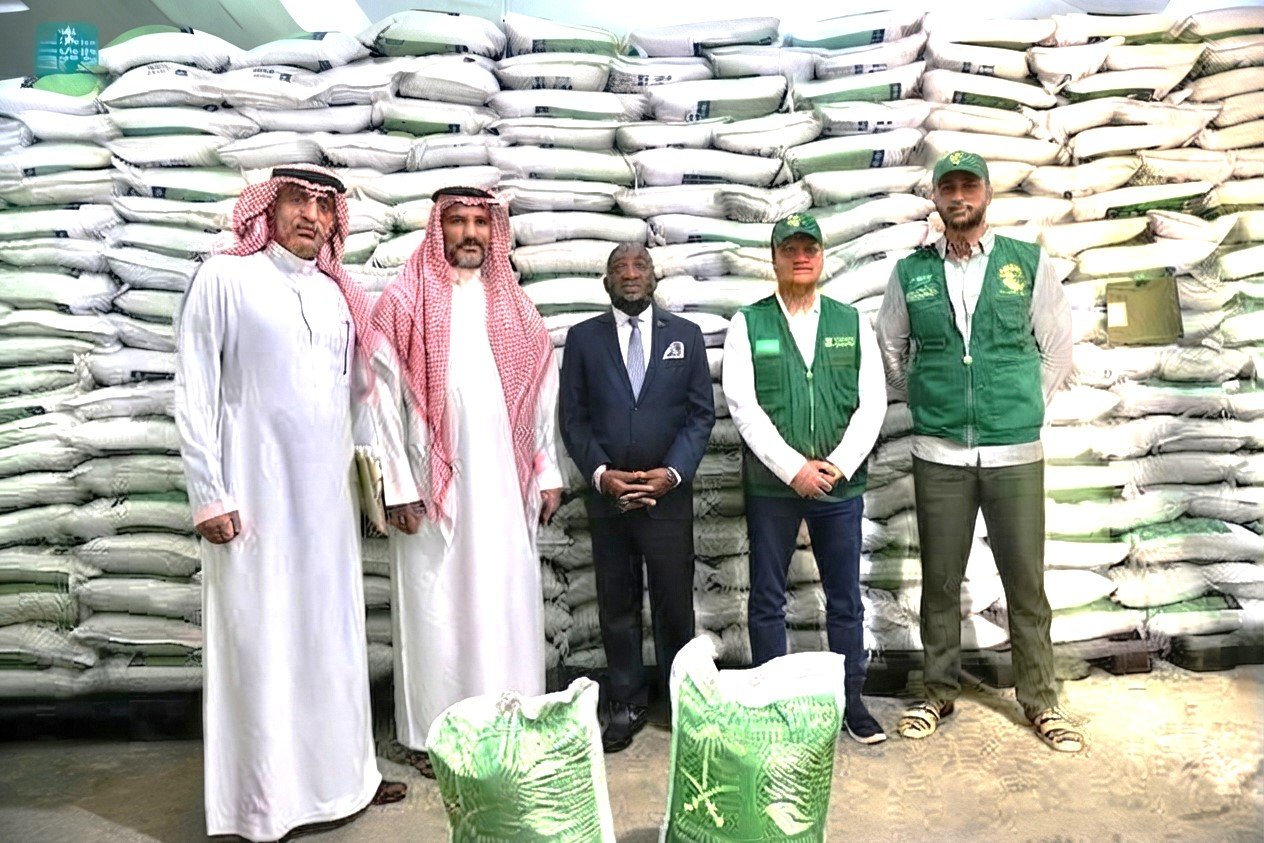
Former General Services Agency (GSA) Director General Madam Mary T. Broh has told Criminal Court “C” that former Foreign Minister Dee-Maxwell Saah Kemayan instructed her to move Saudi-donated rice from the National Disaster Management Agency (NDMA) to the GSA but never told her why the rice had to be moved.
Madam Broh said Kemayan simply instructed her to move the rice as soon as possible, and she followed the order because he was the Minister of Foreign Affairs at the time.
“Amb. Kemayan, never gave me a reason why he wanted the rice to be transferred and/or move, he just told me that he wanted the rice to be moved as soon as possible,” Broh testified.
Her testimony came Monday, September 28, when she appeared as a defense subpoena witness in the ongoing trial involving several former government officials over the handling and distribution of the $500,000 Saudi-donated rice.
Broh said she was contacted by Kemayan while serving as GSA Director General and was asked to assist with the distribution of the rice.
She said Kemayan later called for a meeting at the GSA involving the Ministry of Foreign Affairs, Ministry of Internal Affairs, NDMA and GSA.
According to Broh, Kemayan chaired the meeting and selected then Deputy Foreign Minister Thelma Sawyer to supervise the operation because he was traveling and busy.
She said minutes were taken during the meetings and the agencies agreed to move the rice from the NDMA to the GSA.
Broh said she and Sawyer used their personal resources to move the rice and that she also asked the Liberia Electricity Corporation (LEC) to provide trucks.
She told the court that the rice was inventoried by both the NDMA and GSA after the transfer.
‘He decided for some reason we don’t kknow
During cross-examination, Broh repeated that Kemayan had given her no explanation for the transfer.
“He decided for some reason we don’t know that the rice should be transferred, and I followed the instruction because he’s the Minister of Foreign Affairs,” she said.
Broh said Kemayan instructed her to store the rice at the GSA until further notice.
She maintained that she was carrying out a government instruction and did not question the reason behind the transfer.
“He said“stored the rice at your facility until further notice,” Broh testified.
When asked whether she confirmed her earlier testimony that Kemayan had instructed her to transfer the balance of the rice, Broh said her testimony remained unchanged.
“Yes, what I said earlier remains what I said, based on the information, and request that was made, I’m obliged because that was the government to the government,” she said.
Broh disputes rice figures
Broh also challenged the quantities contained in the indictment.
The indictment alleges that 25,054 bags of 25kg Saudi-donated rice, valued at US$425,918, could not be accounted for.
But Broh rejected the figure of 11,200 bags cited during the proceedings as part of the quantity transferred to GSA.
“The 11,200 bags they talked about are not correct,” she said.
She said there were two deliveries from NDMA to GSA and argued that the figures should be checked against the records.
Broh also questioned the US$425,918 valuation.
“The amount is subject to verification, which is US$425,918.00 is not correct,” she testified.
She further pointed to a separate figure of 13,895 bags transferred to GSA.
Broh said the records relating to the rice were available and that she had turned documents over to the Assets Recovery and Property Retrieval Task Force (AREPT).
‘There was no such thing as Gbarnga hub’
Broh also challenged evidence concerning rice allegedly pre-positioned at a Gbarnga hub.
She said she remembered hearing that between 5,000 and 6,000 bags had gone to the Gbarnga hub before the rice was transferred to GSA.
But she said an NDMA logistics officer, Rosetta Gbasay Gbowah, had denied that any rice went to Gbarnga.
“There was no such thing as Gbarnga hub, so please do not force me to start talking other things,” Broh told the court.
She said the records should be examined to determine where the rice went.
Broh also defended her handling of the operation, saying Kemayan knew what he was doing when he asked her to take over.
“He asked me to rescue the rice and I did,” she said.
Rice distributed to government institutions
Broh acknowledged that some of the Saudi rice went to the Liberia National Police, Ministry of National Defense and Ministry of Justice.
She said the police needed the rice for recruit training, the military for its barracks and the Ministry of Justice for the prison compound.
“The LNP needed the rice for training of their police recruits, the Military needed the rice for the army barrack, MOJ needed the rice for the Prison Compound. So I did that,” she testified.
Broh said she treated the distributions as humanitarian assistance based on government instructions.
She also said government agencies had previously redirected other donated commodities to institutions based on government needs.
Broh says GSA used gate passes
Broh told the court that GSA used gate passes when rice left its warehouse.
She said the gate passes contained information about the driver and vehicle and were used to keep track of rice leaving the facility.
But she acknowledged that GSA could not always follow the rice after it left the warehouse.
“It didn’t go from cradle to grave,” Broh said.
She explained that some communities returned lists of people who received the rice, but that did not happen in every case.
According to Broh, drivers were required to provide their names, driver’s license information and other details before leaving with the rice.
She argued that the same records should be examined when questions are raised about rice leaving the NDMA.
“If GSA is going to be questioned about rice leaving without gate passes, the same thing should be done to NDMA,” she said.
Broh denies knowledge of alleged sale
Broh also denied knowing anything about the alleged sale of the Saudi rice.
She said she was unaware of any committee formed to investigate an alleged sale involving her.
“I know nothing about the sale of the Saudi funded rice, I also know nothing about a committee with my name in it, I never attended such a meeting,” she testified.
She said the only meeting she attended concerning the rice involved instructions to move it from NDMA to GSA.
Street cleaners received rice
Broh also testified about rice given to young people who participated in a cleanup campaign ahead of the inauguration of President Joseph Nyuma Boakai.
She said John Sharruk Siaffa, who was then coordinating the cleanup campaign, approached her for assistance.
Broh said young people involved in the cleanup complained that they had no food while working late into the night.
She said she contacted Siaffa and advised him to write the Internal Affairs Minister, Varney Sirleaf, requesting rice.
Broh said she later received a letter from Sirleaf authorizing the distribution.
She disputed the 1,050-bag figure referenced in the indictment, saying the actual quantity was higher.
“I know that the indictment says 1050 bags, but it is more than that; when you look at the gate passes, you will know that JNB/JKK picked more than 1050 bags,” she told the court.
Broh says she never saw Saudi concept note
Broh also told the court that she never saw the concept document outlining the intended use of the Saudi-donated rice.
She said she could not say whether the rice was distributed according to the concept document because she had never seen it.
“I did not see the concept note. That information should come from Amb. Kemayan, they never share any concept with me,” she said.
The prosecution had alleged that the rice was intended for disaster victims, including victims of floods, fires and storms.
Several questions concerning the concept document were objected to, and the court sustained the objections.
Another defense witness testifies
Earlier, Elizabeth Sakpah Broh Pennoh testified that she witnessed NDMA distributing rice to fire and flood victims in Electoral District #9.
Pennoh said she saw distributions in communities including 12th Street, 24th Street, Lakpazee, Doloville and Rottow Town.
She clarified, however, that she was not an NDMA employee.
When asked who received 200 bags of rice on behalf of the Matadi community, Pennoh said she was not present when the rice was received.
“I was not present when the rice was received, but I witness the distribution,” she testified.
Pennoh said she became involved in the district’s activities after the death of her daughter, former District #9 Representative Munah Pennoh Youngblood, and later worked with Saah Foko, who succeeded her.
The court later discharged her with thanks.
The case involves allegations of theft of property, economic sabotage, misuse of public money, property or records, illegal disbursement or expenditure of public money, misapplication of entrusted property, abuse of office and criminal conspiracy.
The defendants have denied the allegations and remain presumed innocent unless proven guilty.