
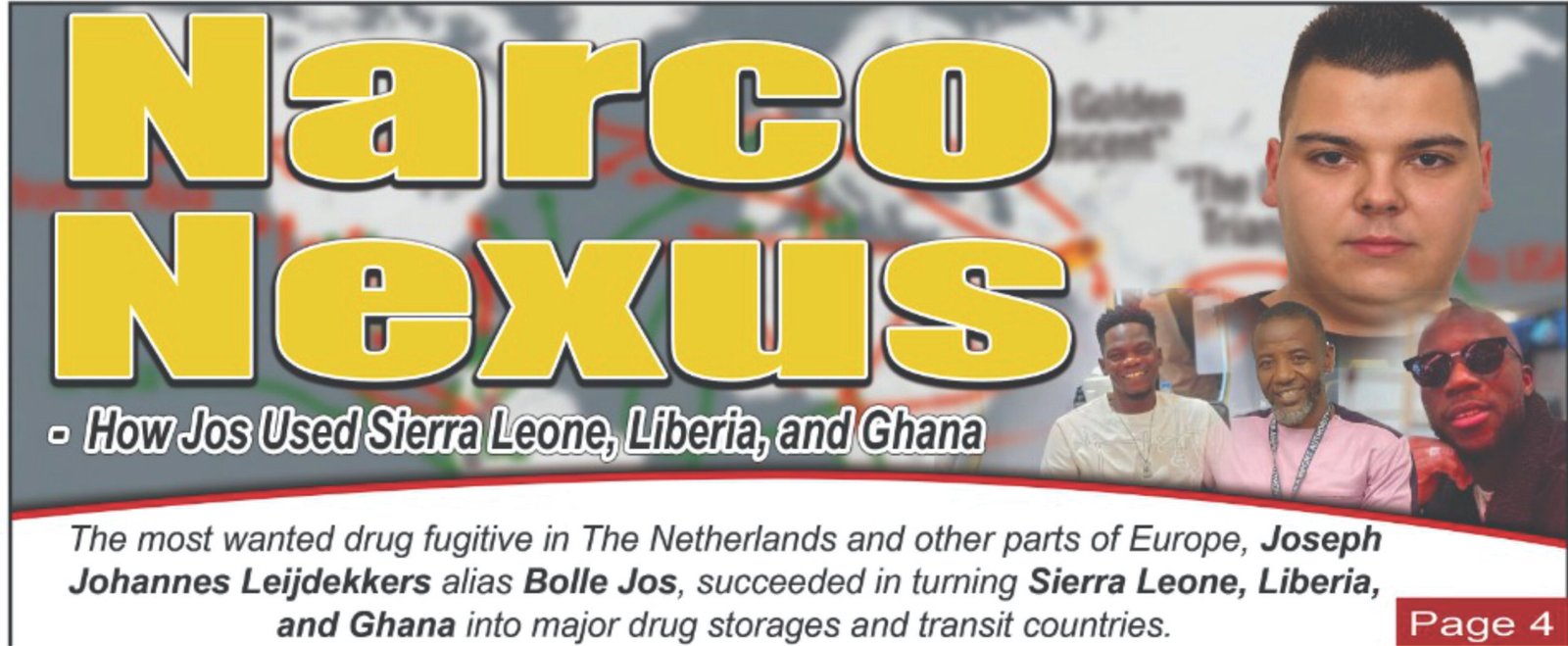
The most wanted drug fugitive in The Netherlands and other parts of Europe, Joseph Johannes Leijdekkers alias Bolle Jos, is alleged to have used Sierra Leone, Liberia, and Ghana as major drug storage and transit points as part of a wider cocaine trafficking network.
The recent wave of major cocaine seizures across West Africa has raised questions about whether several cases that appeared unrelated could be connected.
From Sierra Leone to Liberia and Ghana, the name of Leijdekkers has surfaced as authorities investigate the movement of cocaine from South America through West Africa and onward to Europe.
Leijdekkers, better known as “Bolle Jos,” has been wanted by European authorities for years over his alleged role in international cocaine trafficking. European authorities have convicted him in absentia, while his reported activities in West Africa have drawn growing attention.
Sierra Leone at the centre
Sierra Leone has become a major focus of reporting about Leijdekkers.
Reuters reported in January 2025 that the Dutch fugitive was believed to be living in Sierra Leone and had appeared at a church service attended by President Julius Maada Bio and members of his family. The report, citing sources, said Leijdekkers was believed to have been under high-level protection in the country.
The Sierra Leonean government denied protecting him and said the matter had been investigated.
A 2026 report by Le Monde also alleged that Leijdekkers had expanded his influence in Sierra Leone and reported claims of a warehouse where large quantities of drugs may have been stored.
Spanish and Dutch authorities have separately linked Leijdekkers to cocaine trafficking investigations involving Sierra Leone. Those reports have made his presence in the country a key part of the wider investigation into his activities.
Liberia enters the picture
Liberia became part of the investigation following the June 8 seizure of cocaine valued at about US$19 million at Roberts International Airport.
Liberian authorities said the shipment was headed for Europe, prompting an investigation into how the cocaine entered the country and who was behind it.
The case has brought George Leroy Harris, Jonathan Adama Momolu and Michael Browne under scrutiny.
Harris and Momolu are reported to hold Dutch passports. Momolu, a co-owner of Private Bar in Paynesville, was picked up by investigators probing the cocaine seizure and is being questioned.
FrontPageAfrica reported that an unidentified suspect, who spoke anonymously because of fears for his safety, described Harris, Momolu and Browne as “triangular operators” and alleged that they worked as foot soldiers for Leijdekkers.
That claim comes from the anonymous source and has not been independently established. The men have not been convicted of drug trafficking on the basis of the allegation.
The Liberian investigation is expected to determine whether the shipment was an isolated case or part of a broader trafficking operation.
Ghana adds another route
Ghana has entered the investigation following a major cocaine seizure in France.
Ghana’s Narcotics Control Commission, NACOC, said three people had been arrested in Ghana over suspected links to Leijdekkers after French customs officers seized nearly four tonnes of cocaine at the port of Dunkirk.
According to Ghanaian authorities, the cocaine was concealed in a container carrying plastic waste from Ghana and was destined for Europe.
NACOC said the suspects were allegedly representing or facilitating Leijdekkers’ activities in Ghana and warned that the country would not serve as a safe haven, transit point or operational base for him.
Leijdekkers’ lawyers have denied his involvement in the Dunkirk shipment, according to reporting by the Organized Crime and Corruption Reporting Project.
The Ghana investigation is continuing, with authorities examining the roles of the three suspects and whether other people in Ghana or abroad were involved.
How the three countries may connect
The reported links between the three countries come from separate investigations rather than a single case.
In Sierra Leone, international reports have placed Leijdekkers in the country and raised questions about his alleged connections there. In Liberia, investigators are examining a major cocaine shipment and individuals whom an anonymous source linked to the Dutch fugitive. In Ghana, authorities have directly announced arrests over suspected links to Leijdekkers.
Those developments have raised the possibility of a regional network, but there is no public evidence showing that every cocaine shipment in the three countries was controlled by Leijdekkers.
The investigations will have to establish whether the people, companies, financial transactions and shipments identified in the separate cases overlap.
Financial and travel records could provide some of the strongest evidence of any connection.
Investigators can examine bank transfers, company ownership, property purchases, telephone records, travel histories and shipping documents to determine whether suspects in Sierra Leone, Liberia and Ghana had dealings with one another or with Leijdekkers.
European seizures could also provide clues if investigators find that containers, companies, shipping agents or addresses match those identified in West African investigations.
Such evidence would be more useful in establishing a regional connection than the mere appearance of Leijdekkers’ name in separate drug cases.
Liberia faces its own questions
For Liberia, the immediate focus remains the cocaine seized at Roberts International Airport.
Investigators must determine who arranged the shipment, who was expected to receive it and whether anyone inside or outside the airport system helped move the drugs.
The questioning of suspects could also help authorities establish the source of the cocaine and its intended destination.
Those findings may show whether Liberia was used for one shipment or whether the country was part of a larger trafficking operation.
A wider West African problem
The cases involving Sierra Leone, Liberia and Ghana also highlight the growing challenge posed by cocaine trafficking across West Africa.
The region’s ports, airports, coastlines and land borders provide criminal groups with multiple routes between Latin America and European markets.
For law enforcement agencies, major seizures are only one part of the fight. Identifying the financiers, organisers, transporters and intended recipients is critical to dismantling the networks behind the shipments.
The Bolle Jos case has added urgency to that effort.
The available evidence shows separate investigations in Sierra Leone, Liberia and Ghana, each raising different questions about the Dutch fugitive and the movement of cocaine through the region. Whether those cases ultimately prove to be parts of one network remains for investigators and courts to establish.