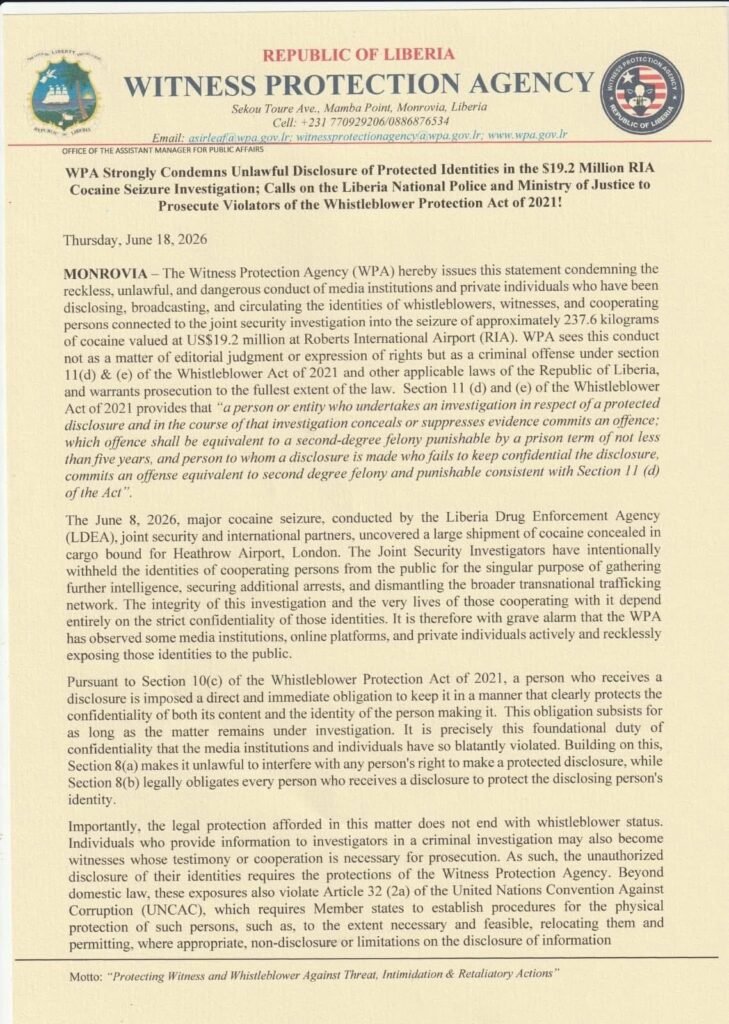

The Witness Protection Agency (WPA) has strongly condemned what it described as the unlawful and dangerous disclosure of protected identities linked to the ongoing investigation into the US$19.2 million cocaine seizure at Roberts International Airport (RIA), warning that those responsible could face criminal prosecution.
In a statement issued Thursday, the WPA accused certain media institutions, online platforms, bloggers, and private individuals of publicly revealing the identities of whistleblowers, witnesses, and cooperating persons connected to the investigation involving approximately 237.6 kilograms of cocaine seized on June 8.
The agency said such disclosures constitute serious violations of Liberia’s Whistleblower Protection Act of 2021 and undermine efforts to dismantle what authorities believe is a broader transnational drug trafficking network.
According to the WPA, investigators intentionally withheld the identities of cooperating individuals to protect the integrity of the investigation, gather further intelligence, secure additional arrests, and identify other members of the alleged drug trafficking operation.
“The integrity of this investigation and the very lives of those cooperating with it depend entirely on the strict confidentiality of those identities,” the agency stated.
The WPA cited Sections 11(d) and 11(e) of the Whistleblower Protection Act, which criminalize the concealment or suppression of evidence during investigations and the unauthorized disclosure of protected information. Violations under these provisions are punishable as second-degree felonies carrying prison terms of no less than five years.
The agency emphasized that persons who receive protected disclosures are legally obligated to maintain confidentiality for as long as an investigation remains active. It argued that the recent exposure of protected individuals directly violates these legal requirements and jeopardizes ongoing law enforcement operations.
Beyond domestic law, the WPA noted that the disclosures may also conflict with international obligations under the United Nations Convention Against Corruption (UNCAC), which requires member states to protect witnesses and reporting persons from retaliation, intimidation, and harm.
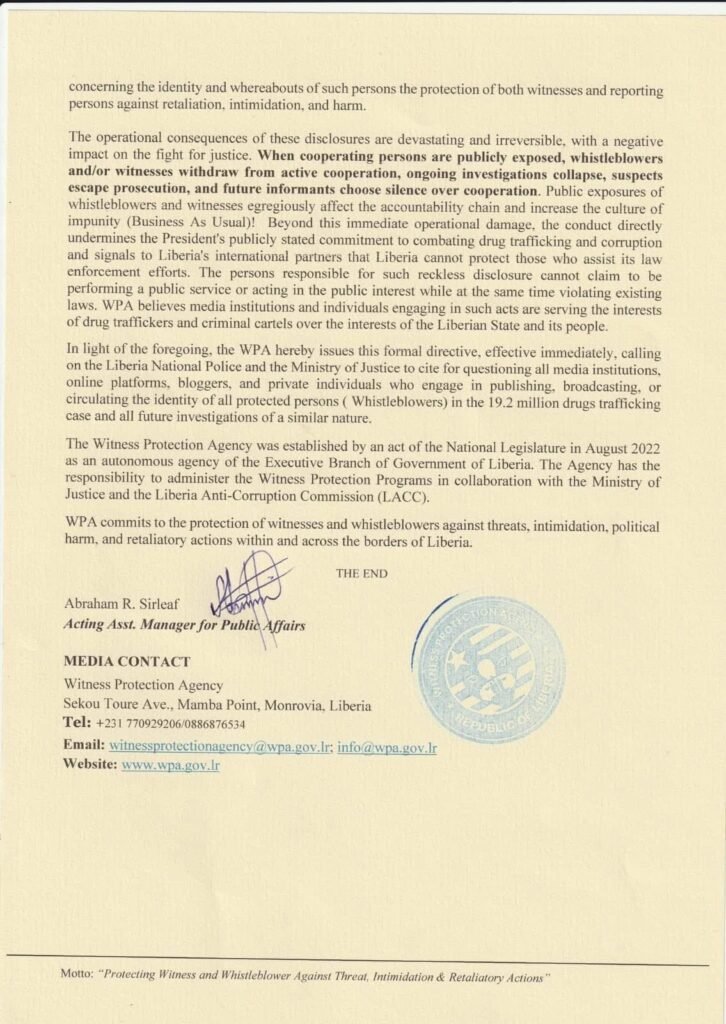
The agency warned that exposing cooperating witnesses can have devastating consequences, including the collapse of investigations, loss of critical evidence, withdrawal of witness cooperation, and the escape of suspects from prosecution.
“The operational consequences of these disclosures are devastating and irreversible,” the statement said, adding that such actions weaken Liberia’s fight against drug trafficking and corruption while damaging the country’s credibility with international law enforcement partners.
As a result, the WPA has formally called on the Liberia National Police and the Ministry of Justice to investigate and prosecute individuals and institutions involved in publishing or circulating the identities of protected persons connected to the cocaine case and future investigations of a similar nature.
The agency further argued that those responsible cannot claim to be acting in the public interest while violating laws designed to protect witnesses and whistleblowers.
Established in 2022 as an autonomous agency of the Executive Branch, the WPA is responsible for administering witness protection programs in collaboration with the Ministry of Justice and the Liberia Anti-Corruption Commission.
The agency reaffirmed its commitment to protecting witnesses and whistleblowers from threats, intimidation, retaliation, and other forms of harm both within Liberia and across international borders.