


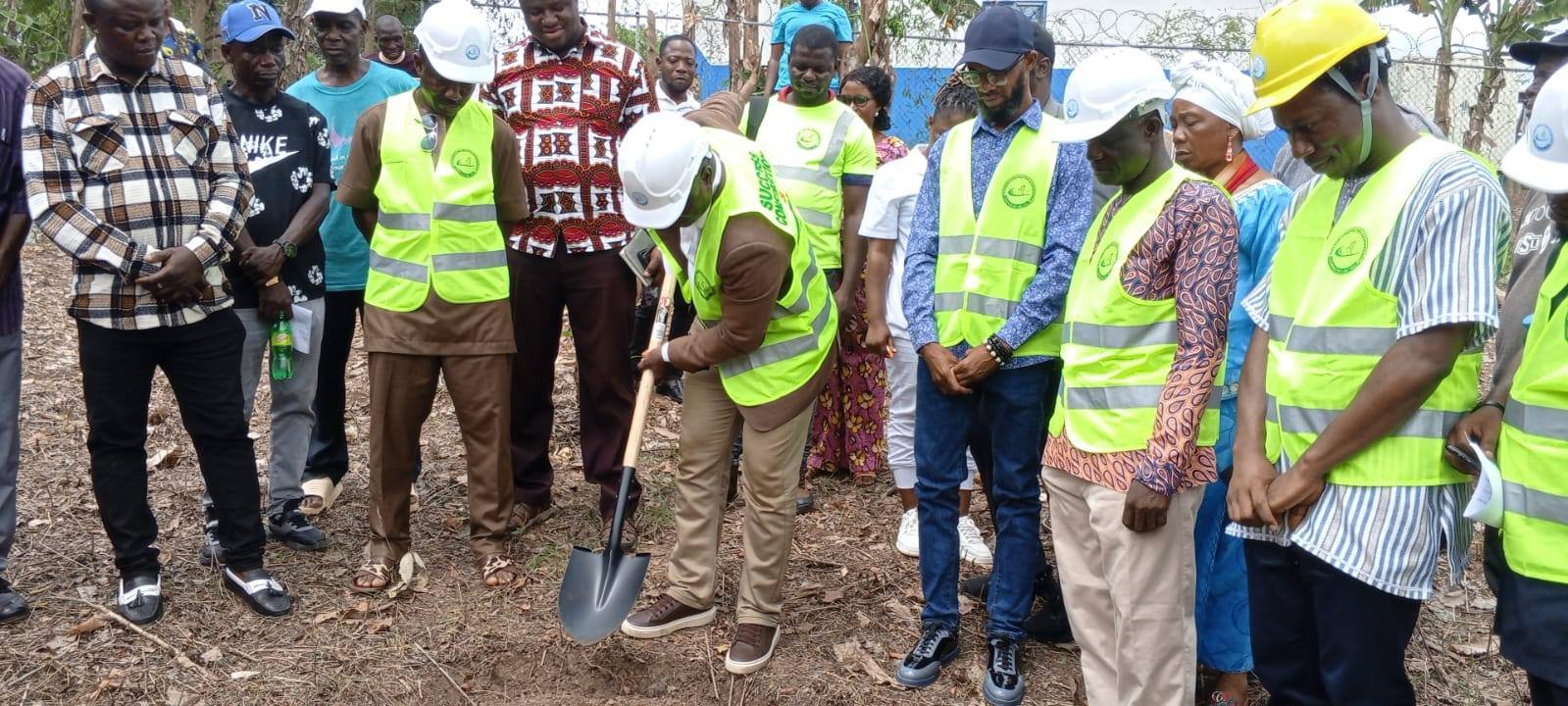
PALALA, Bong County — The Bong County Health Team, in collaboration with Bong County District One Representative Prince K. Koinah and local authorities, has broken ground for the construction of a six-bedroom self-contained staff quarters at the Palala Clinic in District One.
The project, aimed at improving accommodation for healthcare workers and strengthening healthcare delivery in the area, was officially launched on Monday, June 1 during a ceremony attended by health officials, community leaders, residents, and representatives of the contracted construction company.
Providing an overview of the initiative, Bong County Health Team Administrator Sam Siakor disclosed that the project originated from discussions between county health authorities and Representative Koinah regarding support for health facilities in the district.
According to Siakor, the lawmaker previously secured US$10,000 each for the Palala Clinic and the Saywehta health facility through budgetary interventions. Rather than distributing the funds directly, health authorities and local leaders agreed to invest the money into a lasting development project.
“We decided that constructing a staff quarter would have a greater impact because healthcare workers often face challenges finding accommodation in nearby communities,” Siakor said.
He explained that the planned structure will consist of six self-contained rooms equipped with private bathrooms, kitchens, and living spaces to provide health workers with decent and secure housing near the clinic.
However, Siakor revealed that while the project’s Bill of Quantities (BOQ) is estimated at US$48,167, only a portion of the required funding is currently available. He therefore appealed to Rep. Koinah, citizens, local authorities, and development partners to help mobilize additional resources needed to complete the facility.
For his part, Bong County Health Officer Dr. Daanue Paye Zuogbaye called for strong community participation in the project, emphasizing that local contributions could significantly reduce construction costs and accelerate completion.
Dr. Zuogbaye encouraged residents to support the initiative by providing locally available materials such as planks, sand, rocks, and labor.
“When communities take ownership of projects, they succeed,” he stated. “If you can provide wood, provide it. If you can provide sand or rock, provide it. Let us all work together to build a home for our health workers.”
The contracted firm, Success Construction and Engineering Company Inc, also pledged to involve local residents in the construction process.
Speaking on behalf of the company, Administrator Sam Livingston assured residents that qualified local workers would be given opportunities to participate in the project alongside the company’s technical staff.
Livingston, who noted that he attended school in the area, urged residents to safeguard construction materials and support the workforce throughout the duration of the project.
“We want this project to benefit the community. We will employ local people where possible, but we also need everyone’s cooperation to ensure materials are protected and the work proceeds smoothly,” he said.
Meanwhile, Representative Prince K. Koinah described the project as part of his broader effort to strengthen healthcare and educational infrastructure across District One.
The lawmaker explained that the initial allocation to the Palala Clinic was intended as a pilot initiative to demonstrate the impact of targeted investments in public institutions. He expressed satisfaction that the funds were being used for a tangible development project that would directly benefit healthcare workers and residents.
Koinah also highlighted several other development interventions he has supported, including funding for health facilities, educational institutions, and road rehabilitation projects in the district.
He pledged to continue mobilizing support and resources to ensure the successful completion of the staff quarters, making an initial contribution of 2,000 concrete blocks to jumpstart the project.
“We are not going to rely only on the budget,” Koinah said. “We will continue to seek additional support and work with the community until this project is completed.”
Residents and local leaders welcomed the initiative, describing the construction of the staff quarters as a major step toward improving working conditions for healthcare personnel and enhancing access to quality healthcare services in the Palala area.
Construction is expected to commence immediately, with health authorities and community members expressing optimism that the project will help attract and retain skilled medical professionals at the clinic.