


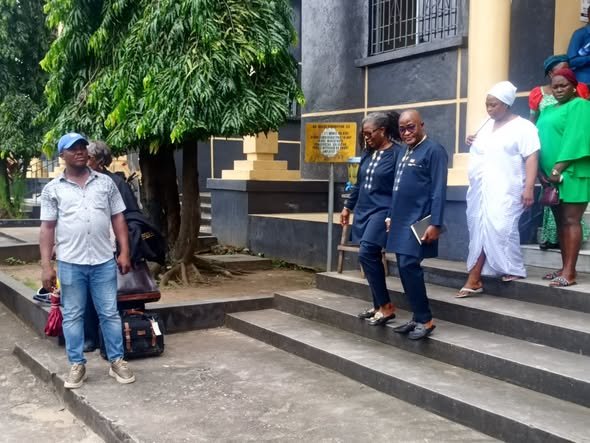
The trial of 13 people accused in connection with the alleged diversion of rice donated by the Kingdom of Saudi Arabia is putting President Joseph Nyuma Boakai’s promise of accountability to the test.
The case, currently before Criminal Court “C,” involves 29,412 bags of 25-kilogram rice valued at about US$500,000. The rice was donated to Liberia for disaster victims and other vulnerable people.
According to the indictment, 25,054 bags, valued at about US$425,918, were diverted or did not reach their intended beneficiaries.
The 13 defendants are charged with Theft of Property, Economic Sabotage, Misapplication of Entrusted Property, Abuse of Office and Criminal Conspiracy.
Before the 15-member panel jury selection, the indictment was read in open court, and all the defendants pleaded not guilty.
The case grew out of an investigation by the Asset Recovery and Property Retrieval Taskforce (AREPT), headed by Cllr. Edwin Kla Martin.
The matter did not reach trial without difficulty. Court records show that legal challenges delayed the case, but the Taskforce continued to pursue it until it was returned to Criminal Court “C” for trial.
During the early stage of the proceedings, the court also addressed several issues raised by the defense, including concerns about the status of one person originally named in the case and a request by newly hired defense lawyers for more time to study the case documents.
The significance of the case lies in what the rice was meant for. It was humanitarian assistance intended for people affected by disasters and other vulnerable Liberians.
The allegation that thousands of bags were diverted has therefore raised serious questions about whether the rice reached the people it was meant to help.
For the Boakai administration, the trial is one of the first major public tests of its pledge to go after the misuse of public resources.
The government’s message has been that people accused of misusing public property should be investigated and, where there is evidence, made to answer before the courts. In the Saudi rice case, that process has moved from investigation to indictment and now to trial.
Still, the case is far from over.
The defendants have denied the charges, and the prosecution must prove its case in court. AREPT investigated the matter and the government filed the charges, but the final decision on whether the defendants are guilty rests with the court.
For AREPT, headed by Cllr. Martin and his Taskforce, the trial is an important stage in their efforts to investigate allegations involving public resources and pursue those cases through the courts.
For President Boakai, it is also an opportunity to show that his administration’s talk about accountability can move beyond speeches and become action.
No verdict has been reached, and the defendants remain innocent unless and until proven guilty in a court of law.
But the Saudi rice case is now before the court, where the evidence will be heard, challenged and tested.